Description
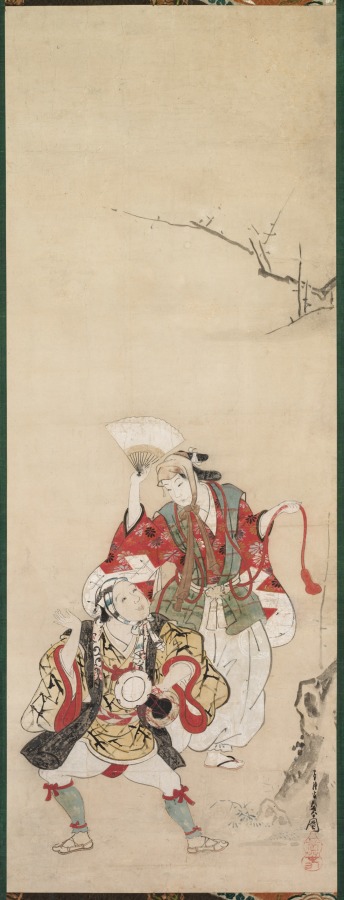
This painting captures the moment when a high-ranking courtesan accompanied by two trainees makes her grand entrance into a salon. The guest of honor, a samurai who reclines beneath a striped robe while dangling his fan, turns from the musical entertainment to gaze at the spectacle of her arrival. The fortunes of everyone in the room depend on how she orchestrates the rest of the evening, as the more the samurai spends on her services, the more trickles down to the other entertainers who are present.
Provenance
(Kenzaburo Marui, Osaka, Japan, sold to the Cleveland Museum of Art) (?–1985); The Cleveland Museum of Art, Cleveland, OH (1985–)
Accession Number
1985.17
Medium
hanging scroll; ink and color on silk
Dimensions
Image: 56.4 x 135.5 cm (22 3/16 x 53 3/8 in.); Overall: 175 x 144.7 cm (68 7/8 x 56 15/16 in.); with knobs: 175 x 154.9 cm (68 7/8 x 61 in.)
Classification
Painting
Credit Line
Leonard C. Hanna Jr. Fund
Tags
Painting Baroque (1600–1750) Ink Silk Painting Japanese Color: Gold
Background & Context
Background Story
Miyagawa Choshun (1682-1752) was a Japanese painter known for the elegantly composed paintings of beautiful women (bijinga) and entertainment scenes that make him one of the most important painters of the early Edo period. Entertainment Scene from c. 1710-53 depicts an entertainment scene in the elegantly composed, colorful manner of the Miyagawa school that distinguishes Choshun's best work from the more general painting of his contemporaries. Choshun was the founder of the Miyagawa school, and his elegantly composed paintings of beautiful women and entertainment scenes represent one of the most accomplished traditions in Edo period painting.
Cultural Impact
Entertainment Scene is important in the history of Japanese painting because it demonstrates the elegantly composed, colorful manner that Choshun brought to beautiful women paintings as the founder of the Miyagawa school. Choshun's elegantly composed paintings of beautiful women and entertainment scenes—combining the elegant composition of the Miyagawa school with the colorful manner that is his most distinctive contribution—represent one of the most accomplished traditions in Edo period painting, and the c. 1710-53 painting shows this tradition at its most elegant.
Why It Matters
Entertainment Scene is Choshun's elegantly composed Edo painting: an entertainment scene rendered in the colorful manner of the founder of the Miyagawa school. The c. 1710-53 painting shows the elegant composition and colorful manner that make Choshun one of the most important painters of beautiful women paintings in the early Edo period.