Description
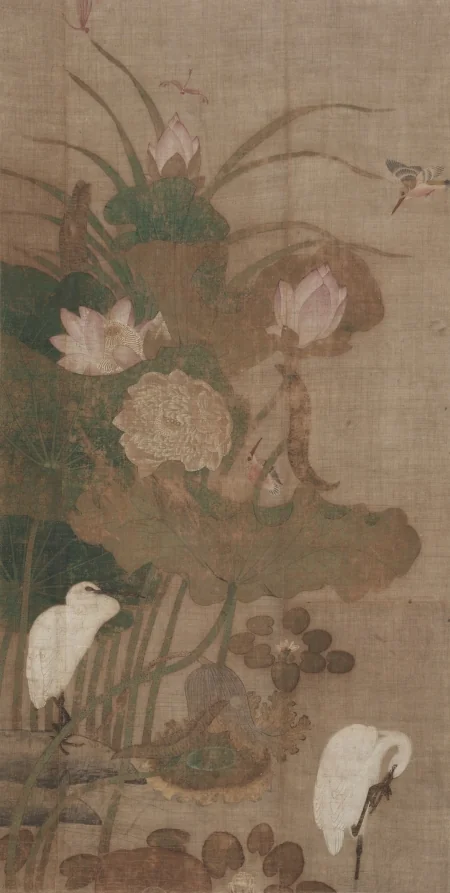
Pairs of herons, kingfishers, and dragonflies punctuate a profusion of lotus in this composition that, given the orientation of the herons and the clustering of motifs in the left-hand side of the work, may have once been the left painting of a pair. Given its subject matter, this hanging scroll may have been hung for display during the summer.
Provenance
(Katsuhiro Kobayashi, Tokyo, Japan, sold to the Cleveland Museum of Art) (?-1985); The Cleveland Museum of Art, Cleveland, OH (1985-)
Accession Number
1985.18
Medium
hanging scroll, ink and color on silk
Dimensions
Image: 112.6 x 57.5 cm (44 5/16 x 22 5/8 in.); Overall: 174.5 x 77.5 cm (68 11/16 x 30 1/2 in.)
Classification
Painting
Credit Line
Dudley P. Allen Fund
Tags
Painting Neoclassical & Romantic (1751–1850) Ink Silk Painting Color: Brown Color: Gray
Background & Context
Background Story
Lotuses, Insects, and Birds from the 1800s depicts lotuses, insects, and birds in the precisely observed, elegantly composed manner of the Japanese flower and bird painting tradition. The lotus is one of the most important flowers in Japanese culture, symbolizing purity and spiritual awakening in the Buddhist tradition, and the combination of lotuses with insects and birds represents the precisely observed, elegantly composed treatment of nature that was one of the most accomplished traditions in Japanese painting. The 1800s date places this in the Edo period, when flower and bird painting was producing some of its most accomplished works.
Cultural Impact
Lotuses, Insects, and Birds is important in the history of Japanese painting because it demonstrates the precisely observed, elegantly composed manner of the flower and bird painting tradition as applied to one of the most important flowers in Japanese culture. The lotus—symbolizing purity and spiritual awakening in the Buddhist tradition—is one of the most important flowers in Japanese culture, and the 1800s painting shows the flower and bird tradition at its most precisely observed.
Why It Matters
Lotuses, Insects, and Birds is an anonymous Edo period painting: lotuses, insects, and birds rendered in the precisely observed manner of the Japanese flower and bird painting tradition. The 1800s painting shows the combination of lotuses with insects and birds that represents one of the most accomplished traditions in Japanese painting.