Accession Number
1985.291
Medium
ink and color on paper
Dimensions
Sheet: 28 x 34.3 cm (11 x 13 1/2 in.)
Classification
Drawing
Credit Line
The Kelvin Smith Collection, given by Mrs. Kelvin Smith
Tags
Drawing Neoclassical & Romantic (1751–1850) Ink Paper Japanese Color: White
Background & Context
Background Story
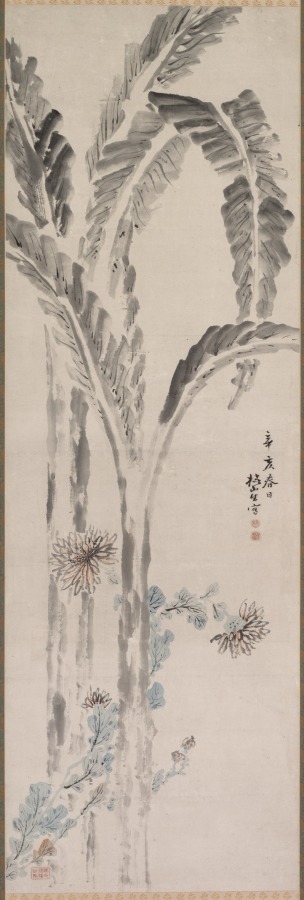
Tsubaki Chinzan (1801-1854) was a Japanese Nanga (Bunjin-ga) painter of the late Edo period, a pupil of Tani Buncho whose work combines the Chinese literati tradition with Japanese decorative sensibility. Banana Plant and Chrysanthemum is a characteristic work in ink and color on paper, depicting two plants that carry rich symbolic associations in both Chinese and Japanese culture: the banana plant (basho) is associated with autumn melancholy and the sensitivity to rain in Chinese poetry, while the chrysanthemum (kiku) is a symbol of longevity and resilience in both traditions. The c. 1845-54 date places this in Chinzan's mature period, when his handling of ink and color had achieved the balance between Chinese brush technique and Japanese decorative elegance that distinguishes his best work.
Cultural Impact
Chinzan's plant paintings occupy an important position in late Edo Nanga painting because they demonstrate how the Chinese literati tradition was adapted to Japanese taste: the brush technique is Chinese, but the color, the compositional elegance, and the decorative sensibility are Japanese. The banana plant and chrysanthemum are both subjects with deep roots in Chinese poetry and painting, but Chinzan's treatment gives them a lightness and elegance that is distinctly Japanese.
Why It Matters
Banana Plant and Chrysanthemum is Chinzan's Nanga at its most balanced: Chinese brush technique combined with Japanese decorative elegance, with two plants that carry deep symbolic associations in both cultural traditions. The banana plant is Chinese autumn melancholy; the chrysanthemum is Chinese and Japanese longevity—and Chinzan paints both with the light touch that distinguishes his work from heavier Chinese models.