Description
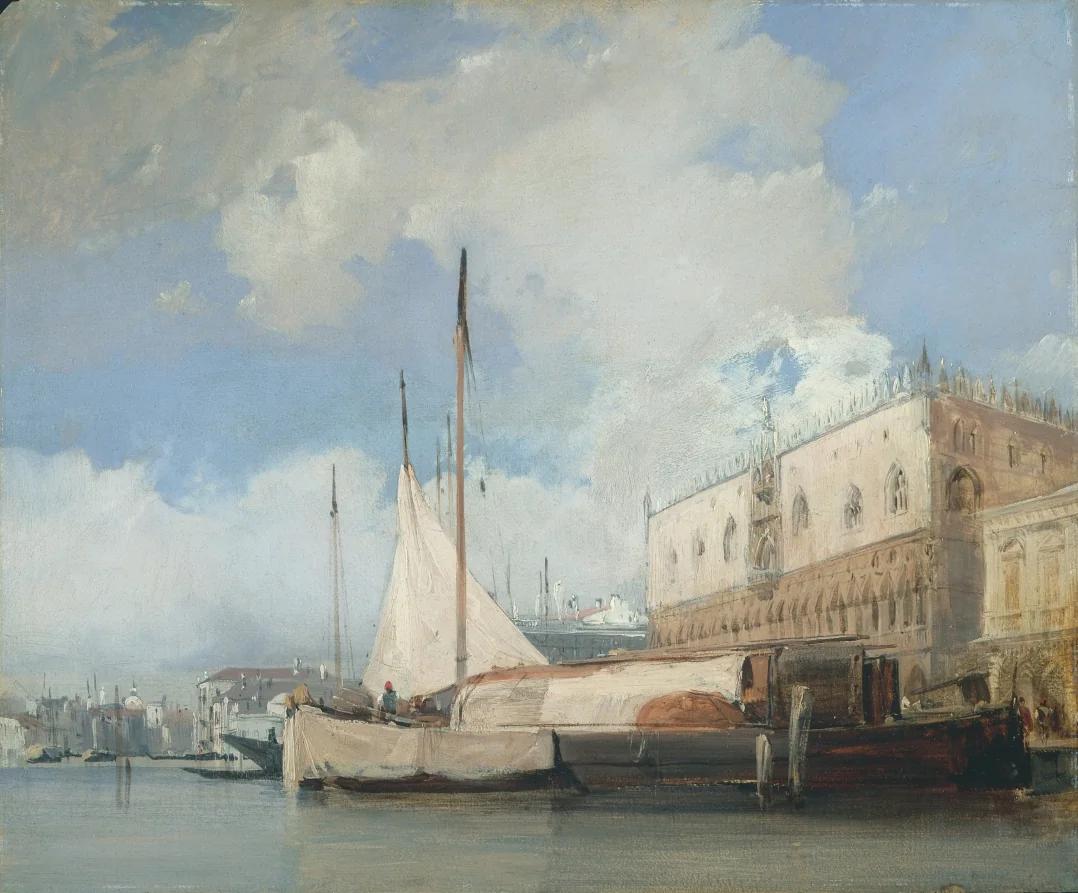
At the age of 22, Bonington achieved overnight success at the official (state sponsored) Paris exhibition known as Salon. Two years later, in 1826, he journeyed to Venice, a city that had long attracted landscape artists. At first, constant rain greatly depressed Bonington, but suddenly the weather changed and Venice was at its glorious best. Bonington frequently painted outdoors, capturing immediate impressions of Venetian architecture and sunlight. He made this particular study from a boat anchored in the lagoon near the Doge's Palace. The thick swirls of paint, with colors mixed together while still wet, indicates how rapidly the artist worked.
Provenance
(Sotheby's London, United Kingdom, possibly Bonington Sale, June 29-30,1829, lot 215, sold to Glynn)
.
.
.
. (possibly 1829); (Sotheby's, London, United Kingdom, February 10, 1838, possibly Mrs. Bonington, the artist's mother, sale, lot 124, to Mawe, bought in). (possibly 1838); (Christie's, London, United Kingdom, possibly William Benoni sale, May 23, 1879, lot 86, sold to Permain. J. Hood (according to label on reverse). (possibly 1879); (Christie's, London, United Kingdom, April 28, 1888, possibly W.A. Turner of Manchester sale, lot 106, sold to Harari & Johns Ltd.)
. (possibly 1888); (Harari & Johns Ltd., London, United Kingdom, sold to the Cleveland Museum of Art) (-1985); The Cleveland Museum of Art, Cleveland, OH (1985-)
Accession Number
1985.56
Medium
oil on millboard
Dimensions
Framed: 53.5 x 61 x 6 cm (21 1/16 x 24 x 2 3/8 in.); Unframed: 35.5 x 42.7 cm (14 x 16 13/16 in.)
Classification
Painting
Credit Line
John L. Severance Fund
Tags
Painting Neoclassical & Romantic (1751–1850) Oil Painting Board British Color: Gray
Background & Context
Background Story
The Doge's Palace, Venice from 1826 shows Bonington painting one of Venice's most iconic buildings with the same atmospheric freedom that distinguishes his Grand Canal views. The Doge's Palace—its white Istrian stone and pink Verona marble rendered in Bonington's characteristic rapid brushwork—is not documented as Canaletto would document it but painted as an atmospheric effect, with the building's architecture dissolving into the Venetian light. The millboard support gives the paint a slightly different quality from canvas, and the small format suits Bonington's preference for intimate, directly observed views rather than grand, composed panoramas.
Cultural Impact
Bonington's Doge's Palace demonstrates the principle that informed all his Venetian views: that architecture is best understood not as a topographic record but as an atmospheric effect. The white and pink stone of the Doge's Palace is not rendered with Canaletto's precision but with Bonington's atmospheric freedom, making the building feel like an element of the Venetian light rather than a structure that exists independently of it.
Why It Matters
The Doge's Palace, Venice is Bonington's atmospheric principle applied to architecture: the building is not documented but perceived, not topographic but atmospheric, painted with a freedom that makes the Doge's Palace feel like an element of the Venetian light rather than a structure that stands apart from it.
Related Artworks
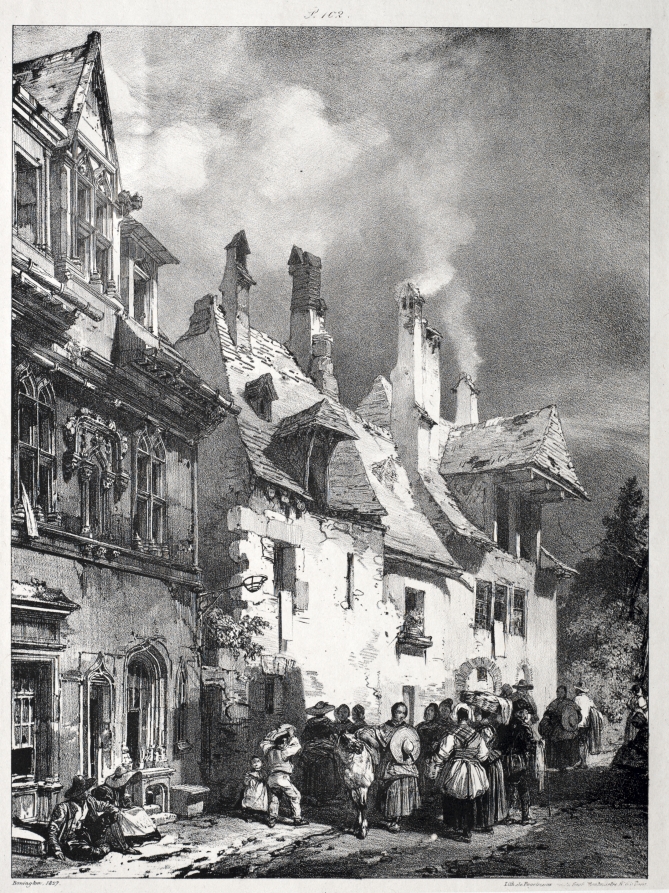
Street in the Outskirts of Besançon, France
Richard Parkes Bonington
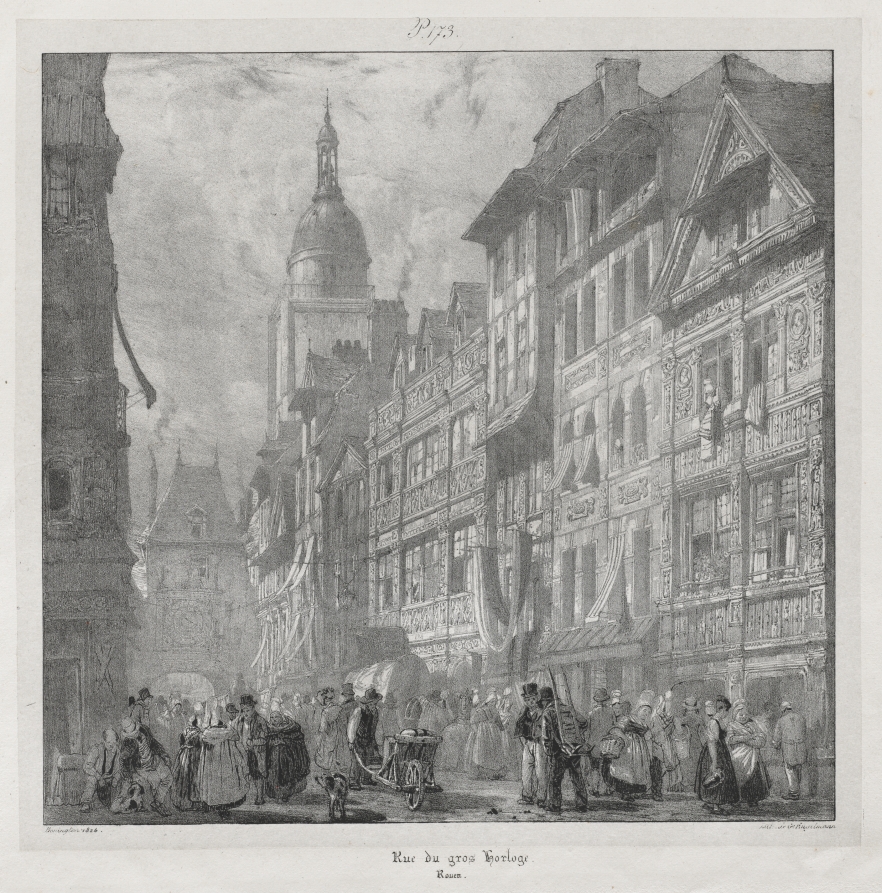
Voyages pittoresques et romantiques dans l'ancienne France, Normandie: Rue du Gros Horloge, Rouen
Richard Parkes Bonington
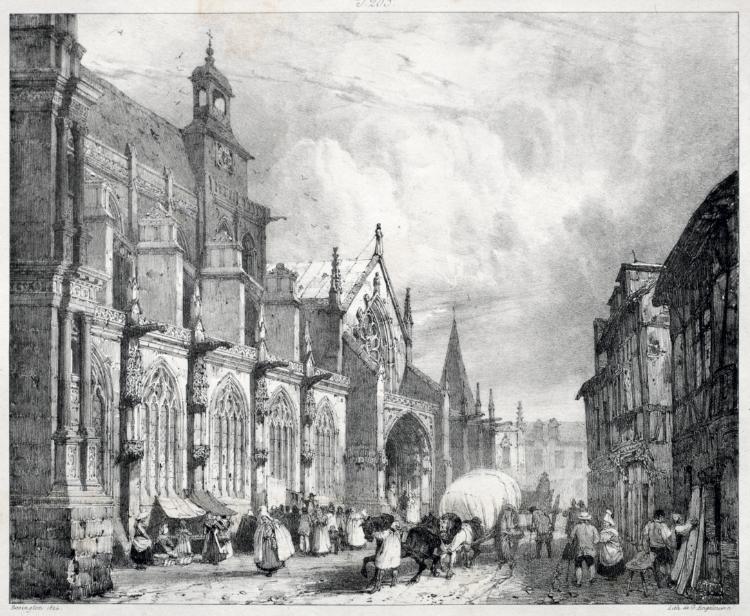
Voyages pittoresques et romantiques dans l'ancienne France, Normandie: Église de Saint Gervais et Saint Protais à Gisors
Richard Parkes Bonington
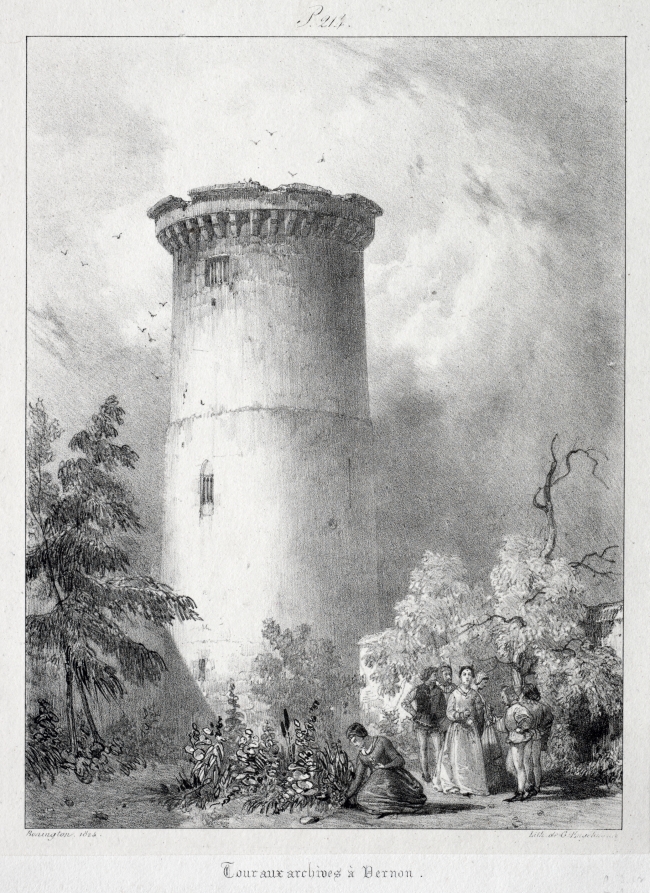
Voyages pittoresques et romantiques dans l'ancienne France, Normandie: Tour aux archives à Vernon
Richard Parkes Bonington