Provenance
George Bickford [1901–1991] and Clara Louise Gehring Bickford [1903–1985], Cleveland Heights, OH, bequest to the Cleveland Museum of Art (?–1985); The Cleveland Museum of Art, Cleveland, OH (1985–)
Accession Number
1985.64
Medium
Gum tempera, ink, and gold on paper
Dimensions
Sheet: 25.3 x 49.1 cm (9 15/16 x 19 5/16 in.)
Classification
Painting
Credit Line
Gift of George P. Bickford
Tags
Painting Neoclassical & Romantic (1751–1850) Ink Tempera Gold Leaf Paper Color: Gold
Background & Context
Background Story
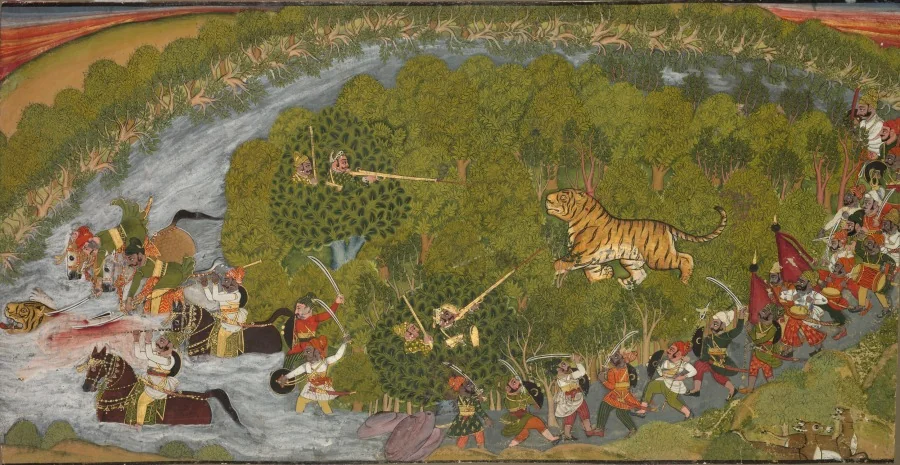
Tiger Hunt from c. 1800 depicts a tiger hunt in the dynamically composed, richly colored manner of the Indian miniature painting tradition. Tiger hunting was one of the most important subjects in Indian miniature painting, representing the power and courage of the rulers who commissioned these works, and paintings depicting tiger hunts represent one of the most dynamically composed traditions in Indian miniature painting. The c. 1800 date places this in the period when Indian miniature painting was producing some of its most dynamically composed works, and the richly colored treatment shows the Indian miniature tradition at its most accomplished.
Cultural Impact
Tiger Hunt is important in the history of Indian painting because it demonstrates the dynamically composed, richly colored manner of the Indian miniature painting tradition as applied to one of the most important subjects in Indian courtly painting. Tiger hunts—representing the power and courage of the rulers who commissioned them—were one of the most important subjects in Indian miniature painting, and the c. 1800 painting shows this tradition at its most dynamically composed and richly colored.
Why It Matters
Tiger Hunt is an anonymous Indian miniature: a tiger hunt rendered in the dynamically composed, richly colored manner of the Indian miniature painting tradition. The c. 1800 painting shows the power and courage of the rulers who commissioned tiger hunt paintings.