Description
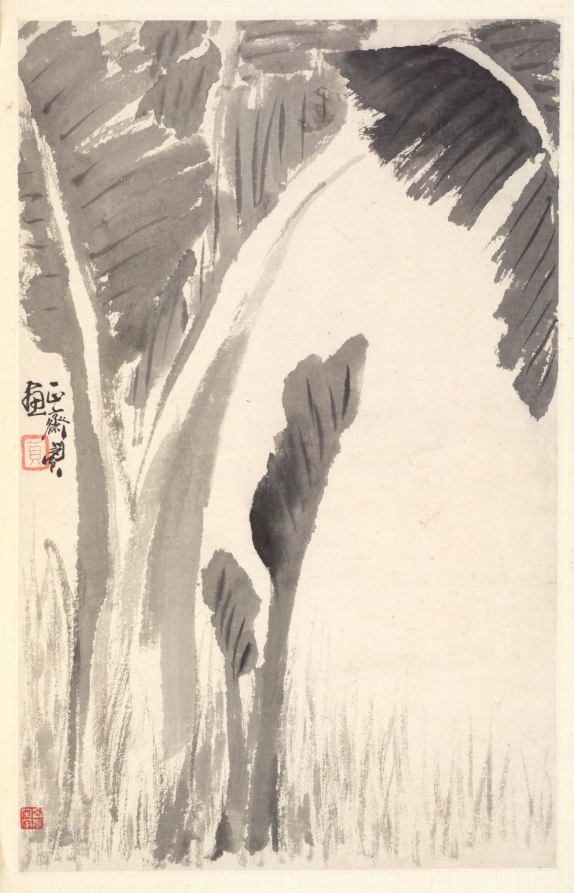
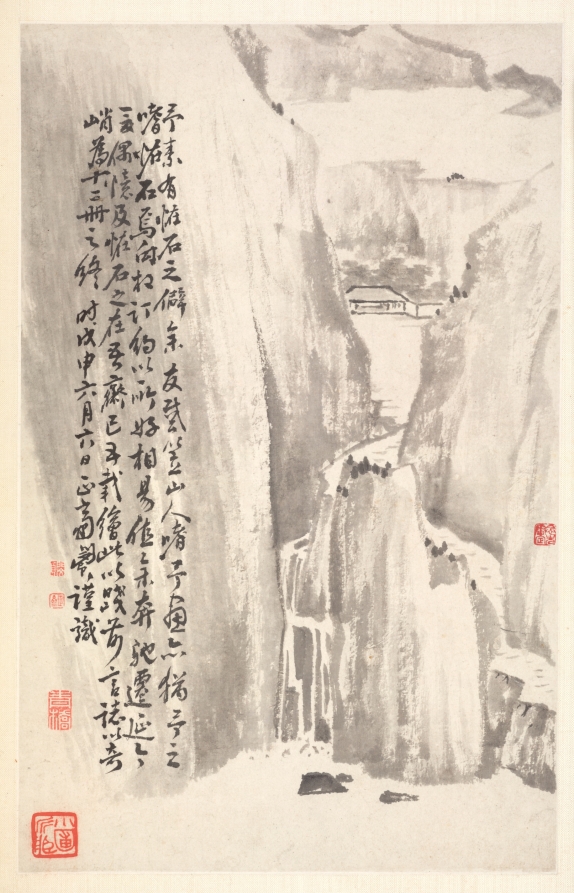
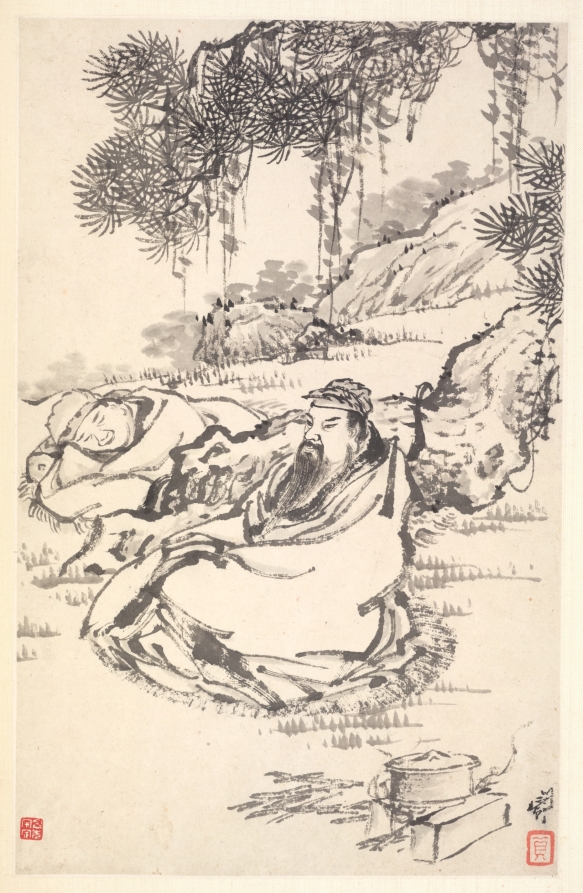
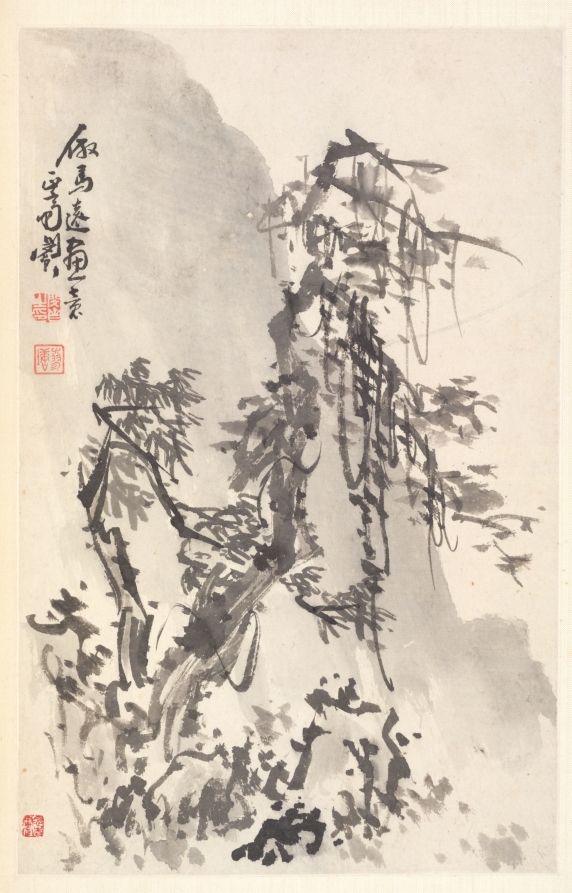
Min Zhen, who was orphaned at age 12 and developed an eccentric personality, was trained by Tang Yin (1682–1756), a writer, playwright, and superintendent of the imperial porcelain workshops in Jingdezhen. The connection to him may have enabled Min to stay in Beijing for a decade from around 1773. It is not clear whether he ever resided in Yangzhou, but his style is in many instances reminiscent of that of Yangzhou artist Huang Shen. This album demonstrates Min’s versatility and mature style in the last years of his life.
Provenance
Daili Shanren 戴笠山人 [active late 1700s] (1788–?); Ni Yun 倪耘 [d. 1864]; Yan Shiqing 顏世清 [1873–1929]; Xu Xiaopu 徐小圃 [1887–1961]; Ding Nianxian 丁念先 [1906–1969] (c. mid-1900s); (Eskenazi Ltd., London, England, sold to the Cleveland Museum of Art) (?–1985); The Cleveland Museum of Art, Cleveland, OH (1985–)
Accession Number
1985.71
Medium
Album of twelve leaves; ink on paper
Dimensions
Each leaf: 29 x 18.4 cm (11 7/16 x 7 1/4 in.); Overall with mount: 35.6 x 22.1 cm (14 x 8 11/16 in.)
Classification
Painting
Credit Line
John L. Severance Fund
Tags
Color: Orange
Background & Context
Background Story
Min Zhen (1730–after 1788) was a Chinese painter known for his eccentric, freely brushed style that placed him among the individualist painters of the Qing dynasty. This album of twelve leaves, dated to 1788 and executed in ink on paper, presents a diverse range of subjects—from figures and animals to landscapes and still-life objects. Min Zhen distinguished himself through his bold, expressive brushwork that conveyed vitality and character with remarkable economy of means.
Min Zhen was born in Jiangxi province and traveled extensively through China, associating with Buddhist monks, scholars, and fellow artists. His style shows the influence of the earlier Ming individualist painters Xu Wei and Chen Hongshou, but Min's work has a raw, spontaneous quality that is entirely his own. The album format—twelve leaves bound together—allowed Min to showcase his versatility, moving from a humorous depiction of a drunken poet to a delicately observed spray of bamboo, from a mythical beast to a serene landscape.
The year 1788, when this album was created, places it near the end of Min Zhen's known career. The Qianlong Emperor was still on the throne, and Qing dynasty culture was at a peak of refinement. Min's unorthodox style existed in productive tension with the more decorous Orthodox School favored by the imperial court. His album represents an alternative stream of Chinese painting—the individualist or eccentric tradition that valued personal expression and spontaneous brushwork over academic correctness. This tradition would in turn inspire later masters of the Shanghai School and even influence the development of modern Chinese painting in the 20th century.
Cultural Impact
Min Zhen belongs to the iconoclastic tradition of Chinese individualist painting, which prioritized personal expression over academic convention. His free brushwork and broad range of subjects challenge the notion of Qing dynasty art as uniformly conservative, revealing a vibrant counter-current of eccentric creativity.
Why It Matters
This album captures Min Zhen's remarkable versatility and unbridled creativity. Leaf by leaf, it demonstrates how Chinese ink painting could encompass both profound philosophical themes and playful observations, all united by the artist's distinctive, spontaneous brush.