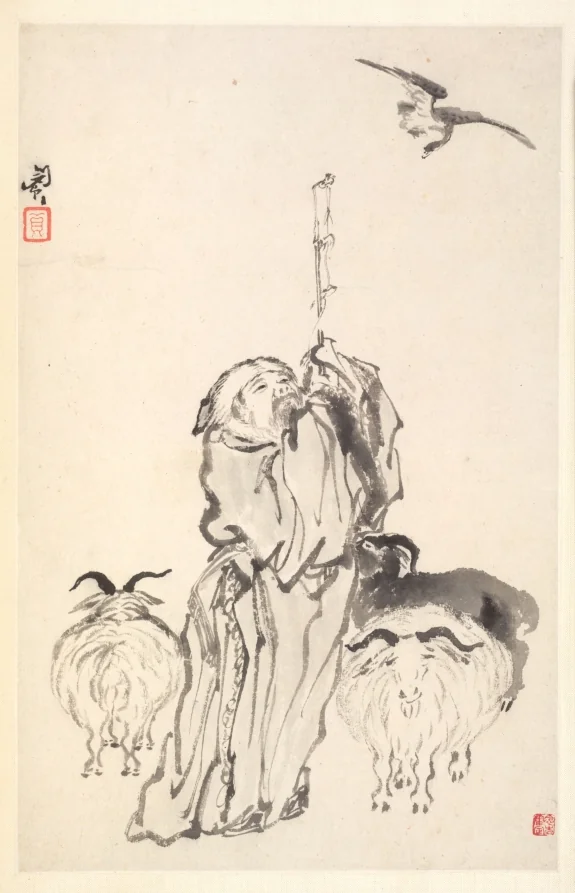
Description
Min Zhen, who was orphaned at age 12 and developed an eccentric personality, was trained by Tang Yin (1682–1756), a writer, playwright, and superintendent of the imperial porcelain workshops in Jingdezhen. The connection to him may have enabled Min to stay in Beijing for a decade from around 1773. It is not clear whether he ever resided in Yangzhou, but his style is in many instances reminiscent of that of Yangzhou artist Huang Shen. This album demonstrates Min’s versatility and mature style in the last years of his life.
Provenance
Daili Shanren 戴笠山人 [active late 1700s] (1788–?); Ni Yun 倪耘 [d. 1864]; Yan Shiqing 顏世清 [1873–1929]; Xu Xiaopu 徐小圃 [1887–1961]; Ding Nianxian 丁念先 [1906–1969] (c. mid-1900s); (Eskenazi Ltd., London, England, sold to the Cleveland Museum of Art) (?–1985); The Cleveland Museum of Art, Cleveland, OH (1985–)
Accession Number
1985.71.10
Medium
album leaf, ink on paper
Dimensions
Sheet: 29 x 18.4 cm (11 7/16 x 7 1/4 in.)
Classification
Painting
Credit Line
John L. Severance Fund
Tags
Color: Gray
Background & Context
Background Story
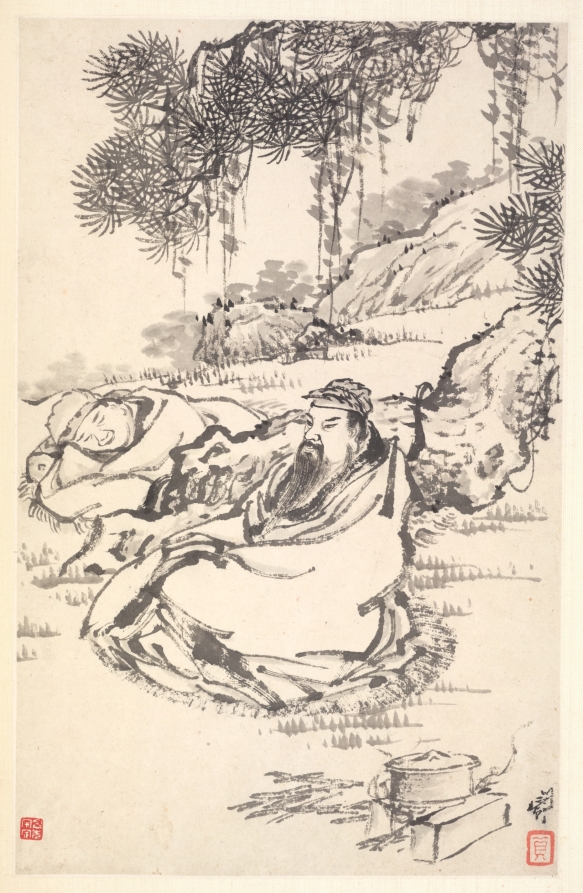
This album leaf from Min Zhen's 1788 album depicts Su Wu (140–60 BCE), a Han dynasty diplomat who became a legendary symbol of loyalty and perseverance in Chinese history. Sent as an envoy to the Xiongnu confederation, Su Wu was captured and held for nineteen years, forced to tend sheep on the remote shores of Lake Baikal. He steadfastly refused to betray the Han dynasty, even when offered high rank by the Xiongnu. His story, recorded in the "Records of the Grand Historian" by Sima Qian, has been celebrated in Chinese literature and art for over two millennia.
Min Zhen renders the stoic shepherd as a gaunt, determined figure seated on a rock, his shepherd's staff beside him. The spare composition—just the figure, a gnarled tree, and a suggestion of distant landscape—focuses attention on Su Wu's weathered face and resilient posture. Min's brushwork is appropriately austere: the figure is built from firm, deliberate strokes, the tree trunk twisted and knotted to echo the subject's endurance. The ink is used with restraint, mainly in middle tones, with darker accents for the figure's eyes and the tree's branches.
Su Wu's story acquired renewed political resonance during the Qing dynasty, when many Ming loyalists faced comparable choices between collaboration and resistance. By painting this subject, Min Zhen (himself a figure of independent spirit) participated in a cultural tradition that used historical exemplars to comment on contemporary moral choices. The leaf operates simultaneously as historical narrative, moral allegory, and character study, demonstrating the multi-layered significance of which Chinese figure painting was capable.
Cultural Impact
The Su Wu story is one of Chinese culture's most enduring moral narratives, representing unwavering loyalty in the face of extreme adversity. Artists across the centuries have returned to this subject, finding new meaning in the Han dynasty diplomat's steadfastness for each generation.
Why It Matters
Min Zhen's spare, dignified treatment of Su Wu captures the moral gravity of this foundational Chinese story. Through economical brushwork and focused composition, the painting transforms a historical figure into a timeless symbol of integrity and endurance.