Provenance
(Yoshiyuki Hosomi, Osaka, Japan, sold to the Cleveland Museum of Art) (?–1986); The Cleveland Museum of Art, Cleveland, OH (1986–)
Accession Number
1986.1
Medium
Hanging scroll; ink and color on silk
Dimensions
Image: 96 x 60.5 cm (37 13/16 x 23 13/16 in.); Overall: 195.6 x 88.9 cm (77 x 35 in.)
Classification
Painting
Credit Line
Mr. and Mrs. William H. Marlatt Fund
Tags
Painting Medieval (500–1399) Ink Silk Painting Color: Orange
Background & Context
Background Story
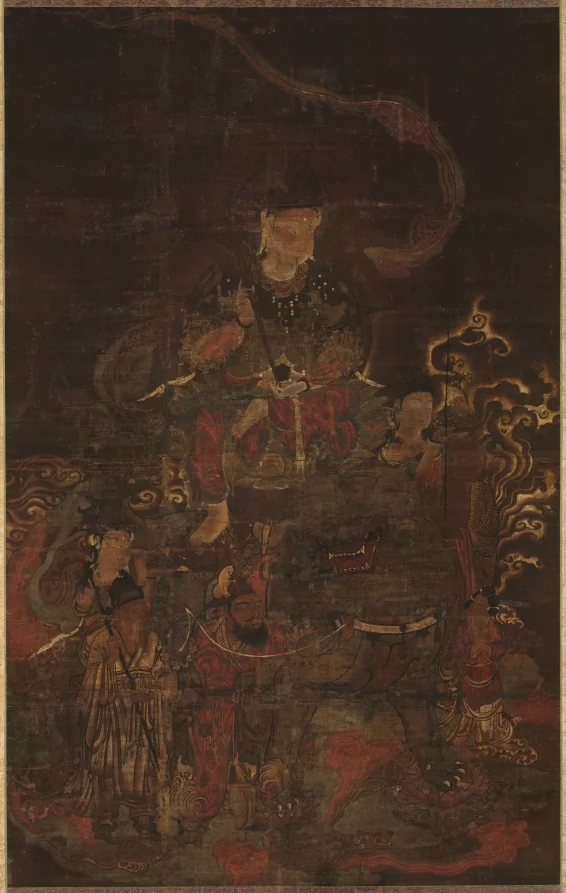
Monju Riding Lion with Attendants from the 1200s depicts Monju (Manjushri)—the bodhisattva of wisdom—riding a lion with attendants in the elegantly composed, richly colored manner of the Japanese Buddhist painting tradition. Monju (Manjushri) is one of the most important bodhisattvas in Buddhism, representing wisdom and insight, and paintings depicting Monju riding a lion represent one of the most accomplished traditions in Japanese Buddhist painting. The 1200s date places this in the Kamakura period, when Japanese Buddhist painting was producing some of its most accomplished works, and the elegantly composed treatment shows the Buddhist painting tradition at its most refined.
Cultural Impact
Monju Riding Lion with Attendants is important in the history of Japanese Buddhist painting because it depicts Monju (Manjushri)—the bodhisattva of wisdom—riding a lion with attendants in one of the most important subjects in Japanese Buddhist art. Monju—representing wisdom and insight—is one of the most important bodhisattvas in Buddhism, and paintings depicting Monju riding a lion represent one of the most accomplished traditions in Japanese Buddhist painting. The 1200s painting shows this tradition in the Kamakura period at its most elegantly composed.
Why It Matters
Monju Riding Lion with Attendants is an anonymous Kamakura period Buddhist painting: the bodhisattva of wisdom riding a lion with attendants rendered in the elegantly composed manner of the Japanese Buddhist painting tradition. The 1200s painting shows one of the most important subjects in Japanese Buddhist art at its most refined.