Accession Number
1986.111
Medium
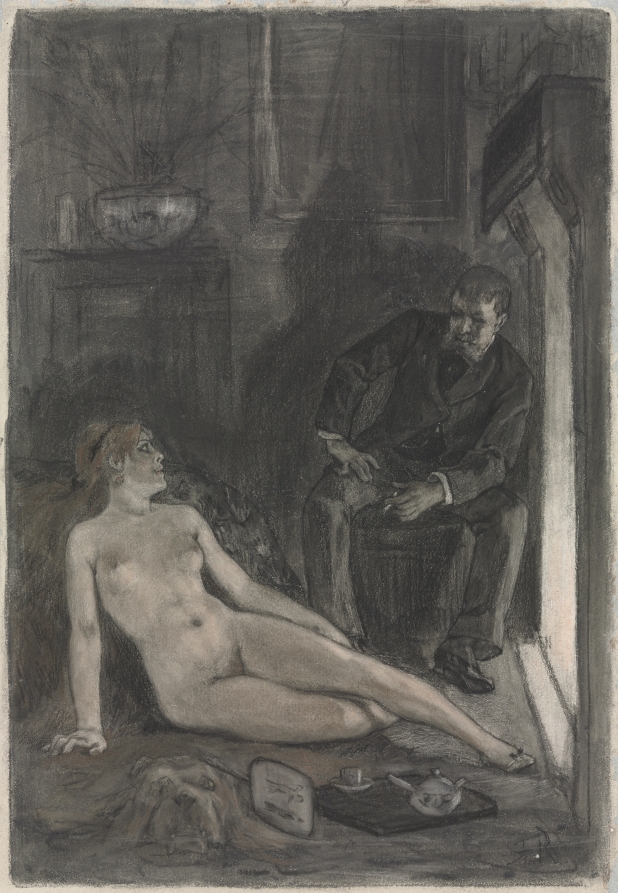
black chalk? and black crayon with stumping (scratched away in places); framing lines in black chalk?
Dimensions
Sheet: 27.8 x 22 cm (10 15/16 x 8 11/16 in.); Image: 20.9 x 13.3 cm (8 1/4 x 5 1/4 in.)
Classification
Drawing
Credit Line
Gift of Louise S. Richards
Tags
Drawing Impressionist & Modern (1851–1900) Belgian Color: Brown
Background & Context
Background Story
Felicien Rops (1833-1898) was a Belgian artist known for the darkly imaginative, precisely observed etchings that make him one of the most important printmakers of the 19th century. The Hanged Man in the Forge from c. 1880 depicts a hanged man in a forge in the darkly imaginative, precisely observed manner that distinguishes Rops's best work from the more general printmaking of his contemporaries. Rops was known for his darkly imaginative, precisely observed etchings that explore the intersection of death, eroticism, and the macabre, and his work influenced the development of Symbolist and Decadent art across Europe. The c. 1880 date places this in his most productive period.
Cultural Impact
The Hanged Man in the Forge is important in the history of printmaking because it demonstrates the darkly imaginative, precisely observed manner that Rops brought to etching as one of the most important printmakers of the 19th century. Rops's darkly imaginative, precisely observed etchings—exploring the intersection of death, eroticism, and the macabre—influenced the development of Symbolist and Decadent art across Europe, and the c. 1880 etching shows this darkly imaginative tradition at its most precisely observed.
Why It Matters
The Hanged Man in the Forge is Rops's darkly imaginative etching: a hanged man in a forge rendered in the precisely observed manner of one of the most important printmakers of the 19th century. The c. 1880 etching shows the darkly imaginative treatment of death and the macabre that influenced Symbolist and Decadent art across Europe.