Provenance
(Chozo Yamanouchi 山內長三, Asaka City, Japan, sold to the Cleveland Museum of Art) (?-1986); The Cleveland Museum of Art, Cleveland, OH (1986-)
Accession Number
1986.49.4
Medium
album leaf; ink and color on silk
Dimensions
Overall: 41.2 x 31.5 cm (16 1/4 x 12 3/8 in.)
Classification
Painting
Credit Line
Kelvin Smith Fund
Tags
Painting Neoclassical & Romantic (1751–1850) Ink Silk Painting Chinese Color: Gold
Background & Context
Background Story
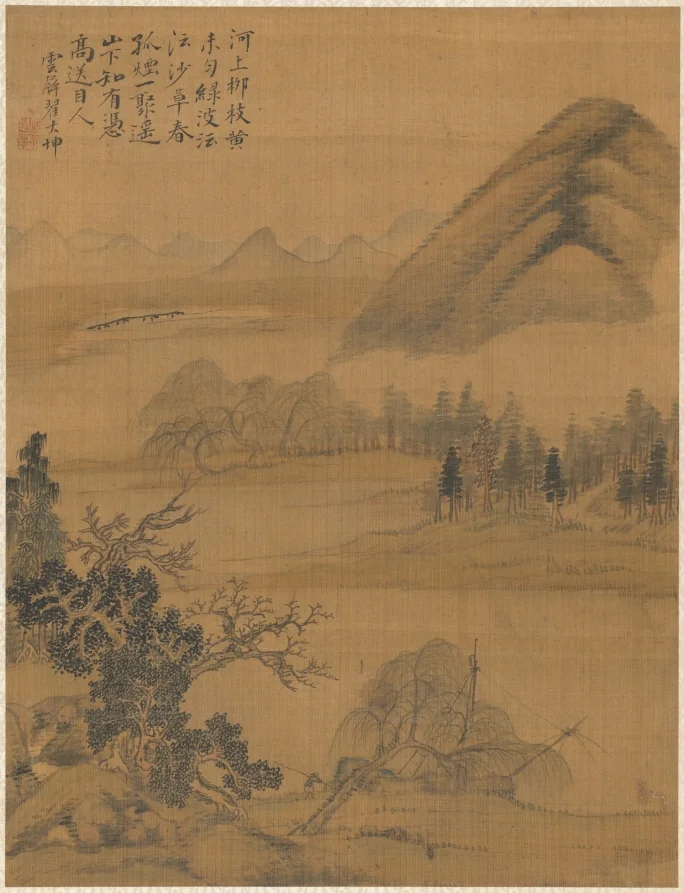
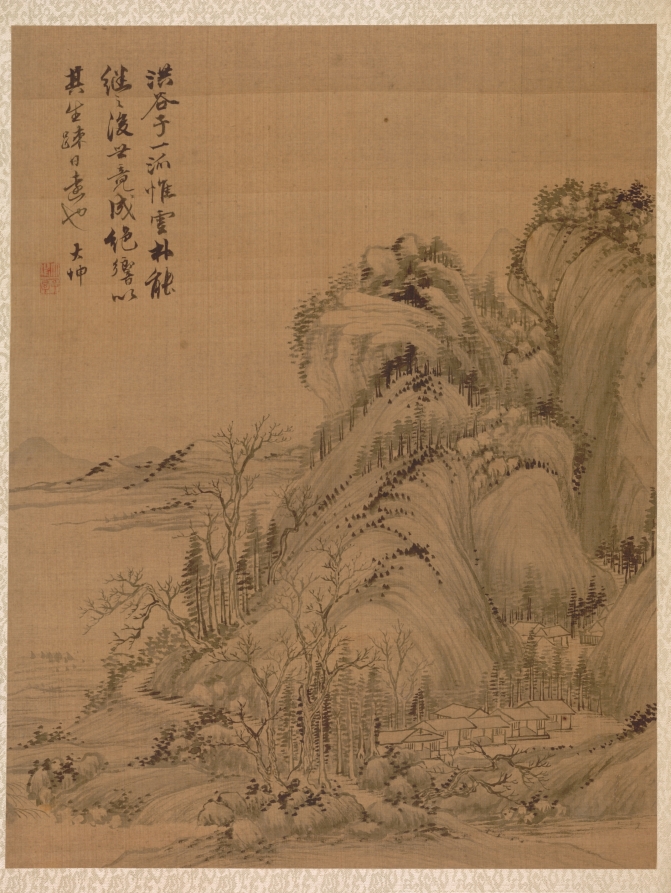
Painting 'in the style of' an earlier master was a fundamental practice in Chinese painting, and Zhai Dakun's explicit reference to Chao Yuan (likely referring to a Song or Yuan dynasty landscape painter) places this leaf within the scholarly tradition of historical engagement. Working in another painter's style was not copying but interpreting — a way of understanding the tradition from the inside by reconstructing its technical and compositional logic. Zhai Dakun's Chao Yuan interpretation filters the earlier master's approach through a Qing sensibility, resulting in a hybrid that is respectful without being slavish.
Cultural Impact
The practice of painting in earlier styles served multiple functions in Chinese art: it demonstrated the painter's education, it paid homage to the masters of the past, and it allowed for creative experimentation within established parameters. Zhai Dakun's 'after Chao Yuan' leaf is both a demonstration of his knowledge of the tradition and a creative reinterpretation of it — the Qing artist's hand is visible even as he follows the Song or Yuan model.
Why It Matters
Landscape in the Style of Chao Yuan is Zhai Dakun's declaration of lineage: 'I know the tradition, I can work within it, and I can make it my own.' The 'after' style is not imitation but conversation across centuries.