Provenance
(Chozo Yamanouchi 山內長三, Asaka City, Japan, sold to the Cleveland Museum of Art) (?-1986); The Cleveland Museum of Art, Cleveland, OH (1986-)
Accession Number
1986.49.5
Medium
album leaf; ink and color on silk
Dimensions
Overall: 41.2 x 31.5 cm (16 1/4 x 12 3/8 in.)
Classification
Painting
Credit Line
Kelvin Smith Fund
Tags
Painting Neoclassical & Romantic (1751–1850) Ink Silk Painting Chinese Color: Orange Color: Gold
Background & Context
Background Story
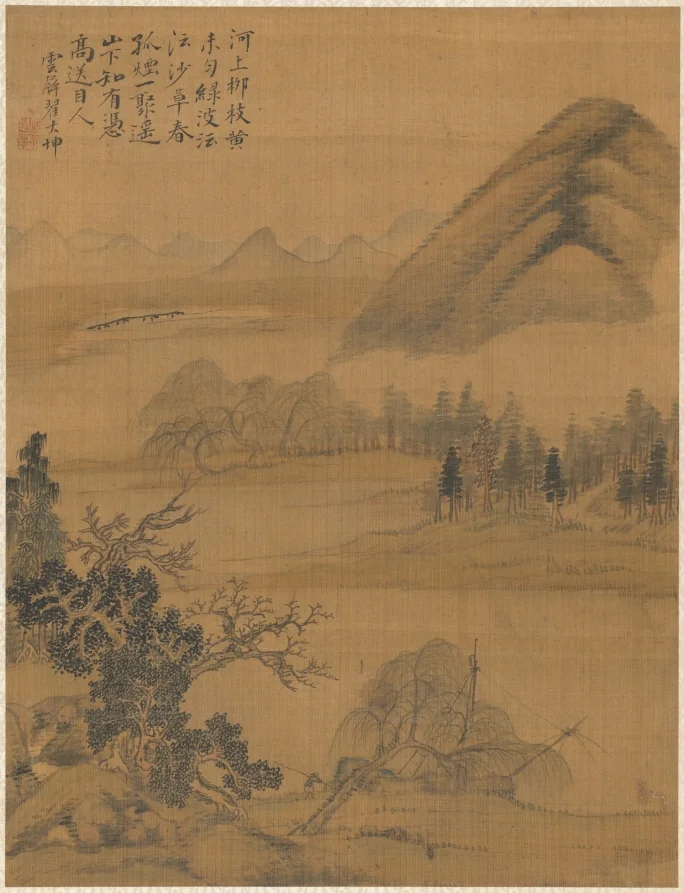
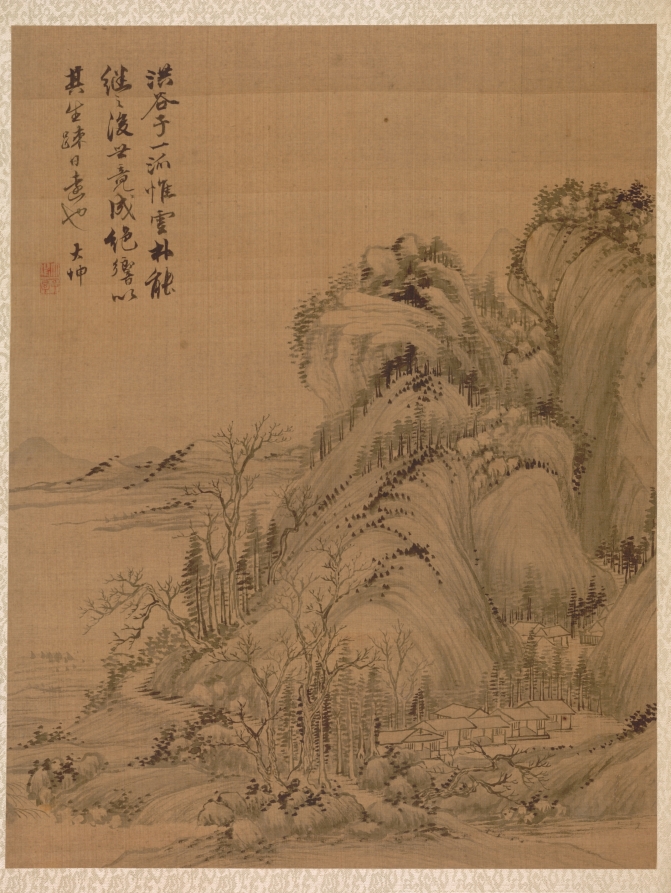
River Village in High Summer is the most narrative leaf in Zhai Dakun's 1775 album, depicting a rural village along a river during the hottest season of the year. The composition includes the characteristic elements of the genre: thatched roofs half-hidden in lush vegetation, a river dotted with small boats, and figures seeking shade or working in the fields despite the heat. Zhai Dakun's use of color — especially the dense greens of summer foliage — is characteristic of Qing album painting, where color on silk allowed for a richness that monochrome ink on paper could not achieve.
Cultural Impact
River village subjects in the Chinese landscape tradition were associated with the poetic ideal of rural retreat, but they also reflected the agrarian reality of Qing China, where the majority of the population lived in precisely such villages. Zhai Dakun's treatment balances these two dimensions: the village is both a poetic ideal and a realistic record of rural life in 18th-century China.
Why It Matters
River Village in High Summer is Zhai Dakun's most human leaf: a specific season, a specific type of settlement, and a specific way of life rendered with the decorative elegance of Qing court painting and the topographic specificity of the landscape tradition.