Accession Number
1986.61
Medium
Gum tempera, ink, and gold on paper
Dimensions
Overall: 32.5 x 20.6 cm (12 13/16 x 8 1/8 in.)
Classification
Painting
Credit Line
Gift of Clara Taplin Rankin
Tags
Painting Neoclassical & Romantic (1751–1850) Ink Tempera Gold Leaf Paper Color: White
Background & Context
Background Story
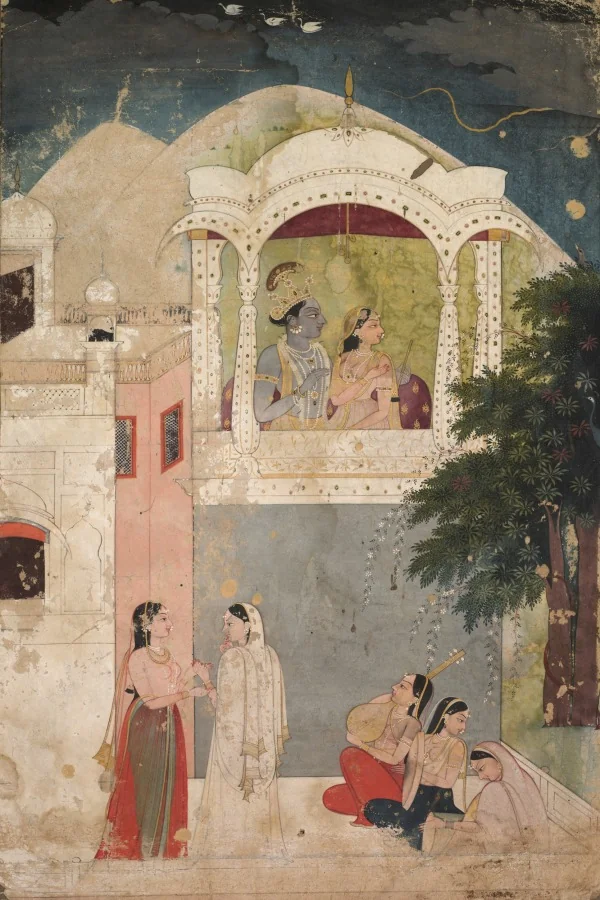
Radha and Krishna Seated on a Balcony from c. 1760 depicts Radha and Krishna seated on a balcony in the richly colored, narrative manner of the Pahari miniature painting tradition. Radha and Krishna were one of the most important subjects in Indian miniature painting, representing the divine love that is central to Hindu devotional practice, and paintings depicting their love represent one of the most accomplished traditions in Indian miniature painting. The c. 1760 date places this in the period when Pahari miniature painting was producing some of its most accomplished works, and the richly colored treatment shows the Pahari tradition at its most refined.
Cultural Impact
Radha and Krishna Seated on a Balcony is important in the history of Indian painting because it depicts the divine love of Radha and Krishna—one of the most important subjects in Hindu devotional practice—in the richly colored, narrative manner of the Pahari miniature painting tradition. Paintings depicting the love of Radha and Krishna represent one of the most accomplished traditions in Indian miniature painting, and the c. 1760 painting shows this tradition at its most richly colored.
Why It Matters
Radha and Krishna Seated on a Balcony is an anonymous Pahari miniature: the divine lovers depicted on a balcony in the richly colored, narrative manner of the Indian miniature painting tradition. The c. 1760 painting shows the love of Radha and Krishna—one of the most important subjects in Indian art—at its most richly colored.