Description
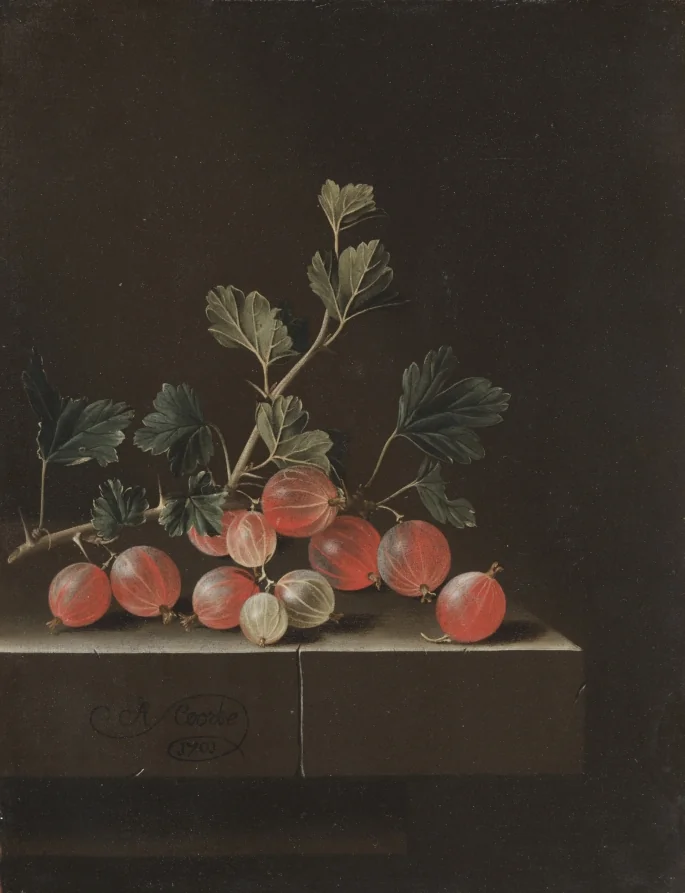
Coorte worked in Middelburg, a wealthy maritime city in the southern part of the Netherlands that fostered a poetic, scientific, and spiritual examination of the natural world. Gooseberries—a modest, local pleasure—could be picked in the wild, although Dutch gardeners in the 1600s were the first to cultivate them to improve their taste. The strong illumination gives the plant a stark grandeur, despite the small scale, and the dark background emphasizes the fruit's delicate translucency. The dessicated flower petals and waxy leaves contrast with the succulent gooseberries, with their skin on the verge of bursting.
Provenance
Auguste Coster [d. 1907], Brussels (-1907); (Le Roy, Brussels, Coster sale, April 4-6, 1907, lot 69, possibly sold to Max Massot) (1907); Max Massot, Belgium, sold to P. de Boer (-1964); (Kunsthandel P. de Boer, Amsterdam, sold to Mrs. Wulf, The Hague)1 (1964); Mrs. Wulf, The Hague, exchanged with P. de Boer for a marine painting by J. van Diest (1964-1975); (Kunsthandel P. de Boer, Amsterdam, sold to Johnny Oppenheimer) (1975); Johnny Oppenheimer, Tönnersjö, Eldsberga, Sweden, consigned to Charles Roelofsz Gallery, Amsterdam1 (1975-1986); (Charles Roelofsz Gallery, Amsterdam) (1986); (Sam Nijstad, The Hague, and K. Waterman Gallery, Amsterdam, sold to the Cleveland Museum of Art) (1986); The Cleveland Museum of Art, Cleveland, OH (1987-)
Accession Number
1987.32
Medium
oil on paper mounted on wood
Dimensions
Framed: 45.5 x 38.5 x 4.5 cm (17 15/16 x 15 3/16 x 1 3/4 in.); Unframed: 29.7 x 22.8 cm (11 11/16 x 9 in.)
Classification
Painting
Credit Line
Leonard C. Hanna Jr. Fund
Tags
Painting Baroque (1600–1750) Oil Painting Dutch Color: Brown
Background & Context
Background Story
Adriaen Coorte's "Gooseberries on a Table" is a masterpiece of restraint and intensity. Against a dark background, a single sprig of gooseberries lies on a stone ledge, illuminated by a strong, focused light that gives the modest fruit an almost monumental grandeur. The plant's translucent berries, some beginning to burst with ripeness, contrast with its dessicated flower petals and waxy leaves, creating a meditation on the cycle of growth, ripening, and decay that lies at the heart of all still life painting.
Coorte worked in Middelburg, a wealthy maritime city in the province of Zeeland in the southern Netherlands. Unlike the bustling artistic centers of Amsterdam and Haarlem, Middelburg fostered a culture of poetic, scientific, and spiritual examination of the natural world that was unique in Dutch culture. The city's collection of natural curiosities (the " kunstkamer" or cabinet of art) and its thriving botanical gardens created an intellectual environment in which close observation of nature was valued both scientifically and spiritually.
Coorte's gooseberries — a modest, local fruit that could be picked wild, though Dutch gardeners in the 1600s were the first to cultivate them for improved flavor — perfectly embody this Middelburg sensibility. Unlike the lavish pronkstillevens (showpiece still lifes) of his Amsterdam contemporaries, which overflowed with exotic flowers, imported fruits, and expensive tableware, Coorte's paintings focus on single, humble subjects: asparagus, gooseberries, shells, strawberries. His compositions strip away all ornament in favor of concentrated attention, making each painted object a vehicle for contemplating nature's beauty and transience.
Little is known about Coorte's life, and his work was virtually forgotten until the twentieth century. He signed his paintings but left no documentary trace of his training or career. The extreme simplicity of his compositions, the small scale of his works (many are on paper rather than canvas), and his preference for humble subjects set him apart from every other Dutch still-life painter. Modern scholars have recognized in Coorte an artist of extraordinary originality — a painter who, working in a peripheral city, developed a radical minimalism that anticipates the contemplative stillness of modernist art.
Cultural Impact
Coorte's radical simplicity — his insistence on painting single, humble subjects against dark voids — was centuries ahead of its time. His work anticipates the minimalist aesthetic of modern art and the meditative quality of later still-life traditions.
Why It Matters
"Gooseberries on a Table" transforms a handful of everyday fruit into a poetic meditation on beauty, transience, and the power of concentrated attention — demonstrating Coorte's radical vision of still life as spiritual practice rather than material display.
![Saint Bernard and Saint Catherine of Alexandria with the Virgin of the Annunciation [right panel]](https://api.nga.gov/iiif/e6890364-4d99-4684-a62b-5060ee3c3446/full/400,/0/default.jpg)