Description
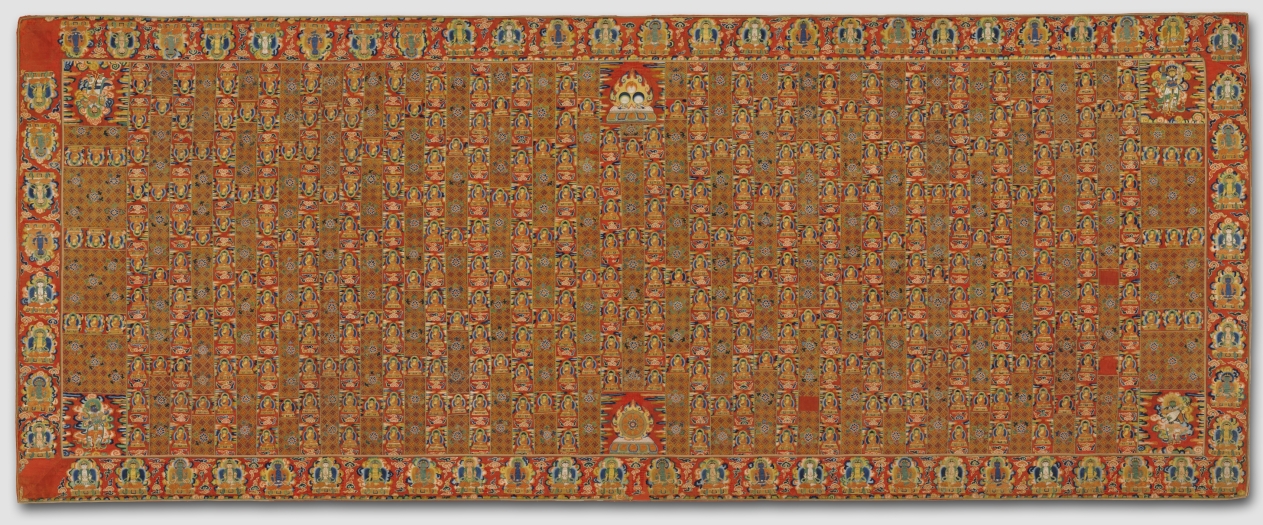
This example of imperial embroidery is one of the earliest surviving Chinese Buddhist robes (kasaya) in the West. Depicting 991 Buddhas, each slightly different, it is constructed out of patches in reference to the legend in which the Buddha's favorite disciple divided a robe he was given into 30 pieces. Patchwork is also a sign of humility. Multiple Buddha images known as “thousand Buddha” designs are seen painted and sculpted on the walls of cave temples in India, Afghanistan, Central Asia, and China, but are rare on garments. The Four Heavenly Kings, guardians of the four directions, occupy the textile’s corners. When draped around the body, the inverted figures in the upper left corner appear right side up. Robes with 25 columns were worn by the highest-ranking clergy on ceremonial occasions.
Provenance
(Spink & Son, Ltd., London, sold to the Cleveland Museum of Art.) (?–1987); The Cleveland Museum of Art, Cleveland, OH (1987–)
Accession Number
1987.57
Medium
silk and gold thread; embroidery
Dimensions
Overall: 119.4 x 302.1 cm (47 x 118 15/16 in.)
Classification
Garment
Credit Line
Leonard C. Hanna Jr. Fund