Provenance
George Bickford [1901–1991] and Clara Louise Gehring Bickford [1903–1985], Cleveland Heights, OH (by 1975); Dorothea Swope [b. 1944], New York, NY, given to the Cleveland Museum of Art (?–1988); The Cleveland Museum of Art, Cleveland, OH (1988–)
Accession Number
1988.120
Medium
Gum tempera, ink, and gold on paper
Dimensions
Image: 25.7 x 17.1 cm (10 1/8 x 6 3/4 in.); Overall: 30.3 x 21.6 cm (11 15/16 x 8 1/2 in.)
Classification
Painting
Credit Line
Gift of Miss Dorothea Swope in memory of Mahadevan Natesan
Tags
Painting Neoclassical & Romantic (1751–1850) Ink Tempera Gold Leaf Paper Color: Red
Background & Context
Background Story
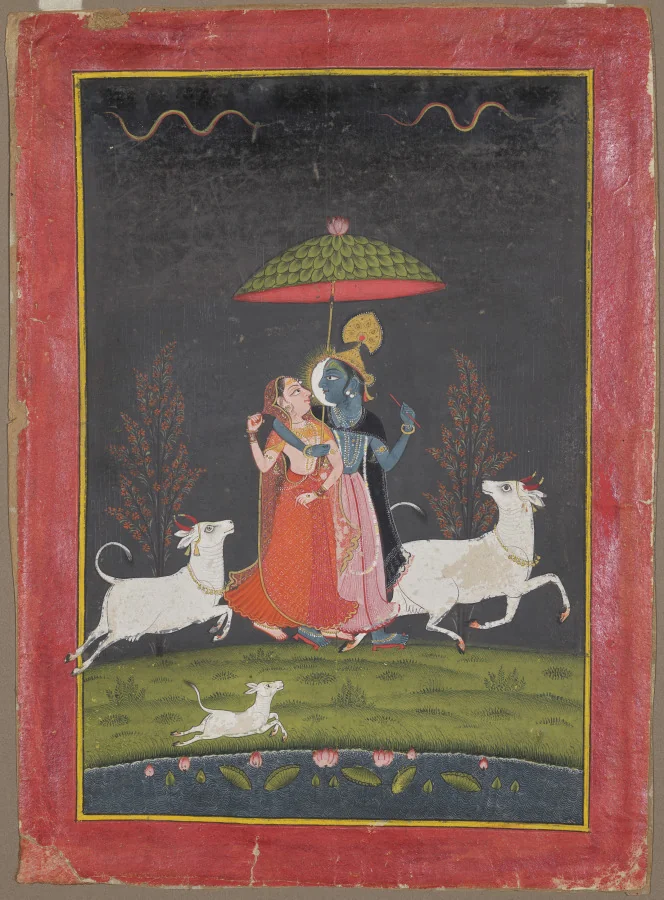
Radha and Krishna in the Rain from c. 1780 depicts Radha and Krishna in the rain in the richly colored, narrative manner of the Pahari miniature painting tradition. The subject of Radha and Krishna in the rain is one of the most poetic subjects in Indian miniature painting, representing the divine lovers seeking shelter together as a metaphor for spiritual union, and paintings depicting this subject represent one of the most accomplished traditions in Pahari miniature painting. The c. 1780 date places this in the period when Pahari miniature painting was producing some of its most accomplished works.
Cultural Impact
Radha and Krishna in the Rain is important in the history of Indian painting because it depicts one of the most poetic subjects in Pahari miniature painting—Radha and Krishna seeking shelter together from the rain as a metaphor for spiritual union. The subject of Radha and Krishna in the rain—representing the divine lovers seeking shelter together—is one of the most poetic subjects in Indian miniature painting, and the c. 1780 painting shows this subject at its most richly colored.
Why It Matters
Radha and Krishna in the Rain is an anonymous Pahari miniature: the divine lovers seeking shelter from the rain rendered in the richly colored narrative manner of the Indian miniature painting tradition. The c. 1780 painting shows one of the most poetic subjects in Indian art at its most richly colored.