Description
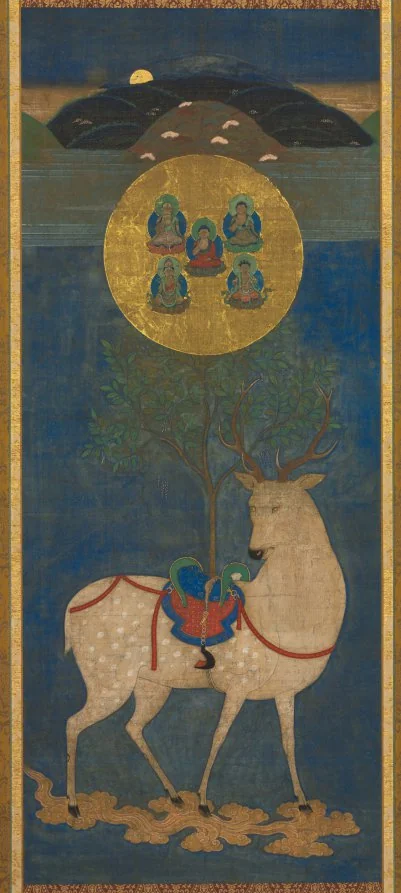
Riding on a rolling cloud, a spotted deer wears a brightly colored saddle. The saddle supports a branch of the evergreen Sakaki tree, trailing wisteria vines that cradle a large golden mirror. Within the mirror sit the five Buddhist manifestations (honjibutsu) of the deities (kami) of the Kasuga Grand Shrine in Nara. The presence of the deer—the vehicle of the deity Takemikazuchi no Mikoto of the first of the five halls of the shrine—and the characteristics of the mountain range at the top of the painting make clear the association with the sacred site of Kasuga. The painting was likely created for an individual’s personal devotions to the Kasuga deities
Provenance
Hinohara collection; (Heisando Co., Ltd., Tokyo, Japan, sold to the Cleveland Museum of Art) (?-1973); The Cleveland Museum of Art, Cleveland, OH (1973-)
Accession Number
1988.19
Medium
hanging scroll; ink, color and gold on silk
Dimensions
Image: 95.6 x 39.1 cm (37 5/8 x 15 3/8 in.); Mounted: 184.2 x 63.8 cm (72 1/2 x 25 1/8 in.)
Classification
Painting
Credit Line
Leonard C. Hanna Jr. Fund
Tags
Painting Medieval (500–1399) Ink Silk Painting Gold Leaf Color: Orange Color: Gold
Background & Context
Background Story
Kasuga Deer Mandala from the mid-1300s to 1400s is a Buddhist painting depicting the sacred deer of Kasuga Shrine in the elegantly composed, richly colored manner of the Japanese Buddhist painting tradition. The Kasuga Shrine in Nara is one of the most important Shinto shrines in Japan, and its sacred deer were believed to be messengers of the gods. Buddhist paintings depicting the sacred deer of Kasuga Shrine represent one of the most accomplished traditions in Japanese Buddhist art, combining the Buddhist painting tradition with the Shinto belief in sacred animals, and the mid-1300s to 1400s date places this in the period of the Northern and Southern Courts and Muromachi periods.
Cultural Impact
Kasuga Deer Mandala is important in the history of Japanese Buddhist painting because it depicts the sacred deer of Kasuga Shrine—one of the most important Shinto shrines in Japan—in a mandala that combines the Buddhist painting tradition with Shinto belief. The Kasuga Deer Mandala—combining Buddhist painting with Shinto belief in sacred deer as messengers of the gods—represents one of the most accomplished traditions in Japanese religious art, and the mid-1300s to 1400s painting shows this syncretic tradition at its most elegantly composed.
Why It Matters
Kasuga Deer Mandala is an anonymous Muromachi period Buddhist painting: the sacred deer of Kasuga Shrine rendered in the elegantly composed manner of the Japanese Buddhist painting tradition. The mid-1300s-1400s painting shows the syncretic combination of Buddhist and Shinto belief that is one of the most important traditions in Japanese religious art.