Description
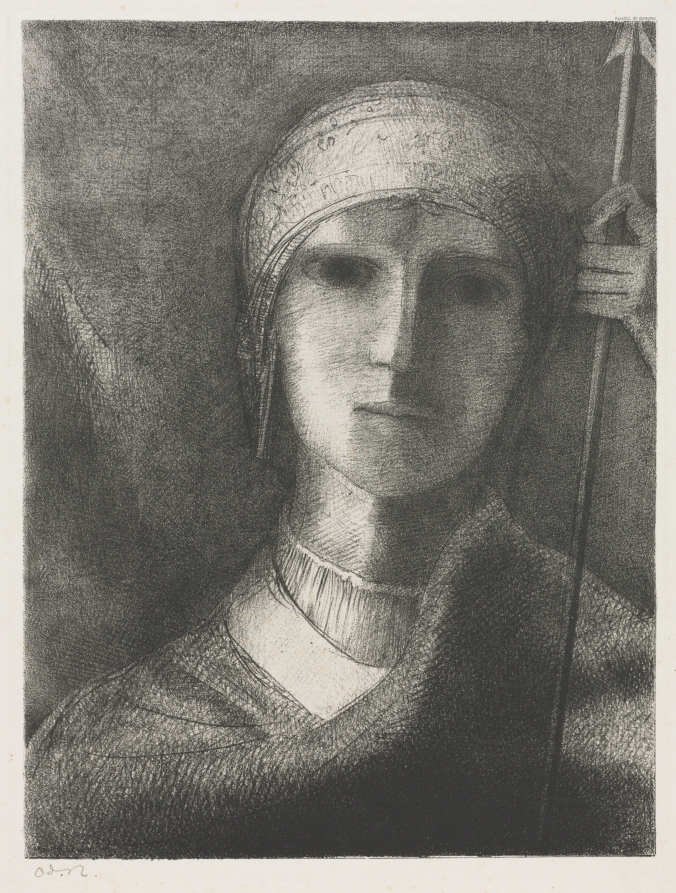
One of Redon’s favorite themes was a head depicted in profile, sometimes separated from the body to symbolize the spirit released from the material world. It also suggests a metaphor for abandoning physical reality for the inner realm of dreams, fantasy, and poetic reverie. This painting conveys the idea of inward-turning vision by framing the head in a series of collapsing rectangles. Conservation analysis confirms that the figure is a woman wearing a helmet and holding a green staff in her right hand.
Provenance
Possibly Gustave Fayet [1865-1925], Béziers (Before 1925); (Jacques Dubourg [1897-1981], Paris, sold to Knoedler & Co.) (Until 1954); (Knoedler & Co., New York, sold to Mildred Andrews Putnam) (1954-1956); Mildred Andrews Putnam [1890/92-1984], Cleveland, OH, by descent to her son, Peter Andrews Putnam (1956-1984); Peter Andrews Putnam [1925-1987], Cleveland, OH, given to the Cleveland Museum of Art (1984-1987); The Cleveland Museum of Art, Cleveland, OH (1988-)
Accession Number
1988.91
Medium
oil on paper mounted on canvas
Dimensions
Framed: 69 x 54.5 x 7.5 cm (27 3/16 x 21 7/16 x 2 15/16 in.); Unframed: 53.3 x 38 cm (21 x 14 15/16 in.)
Classification
Painting
Credit Line
Gift of the Mildred Andrews Fund
Tags
Painting Impressionist & Modern (1851–1900) Oil Painting Canvas French Color: Gold
Background & Context
Background Story
Symbolic Head from around 1890 comes from Redon's transition period between the monochrome noirs and the luminous color works of his last decades. The head is rendered in oil on paper (a support that allows for more experimentation than canvas), and the title explicitly identifies it as 'symbolic' rather than a portrait of a specific individual. The head emerges from a dark, atmospheric background that recalls the noirs, but the use of oil color (rather than charcoal) allows for a warmth and chromatic richness that the noirs could not achieve. This transitional work points toward the luminous color works that would dominate Redon's later career.
Cultural Impact
The transition from Redon's noirs to his color works was not a sudden reversal but a gradual evolution, and Symbolic Head represents a key moment in that evolution. The subject is still the visionary head that had been central to the noirs, but the medium has shifted from charcoal to oil, and the color—while still subdued—has a warmth and richness that the noirs could not achieve. This is Redon finding color before he fully commits to it.
Why It Matters
Symbolic Head is Redon in transition: the visionary subject of the noirs is still present, but oil on paper has replaced charcoal, and color is beginning to emerge from the darkness. The head is still symbolic—still emerging from the unconscious—but it is no longer monochrome. The light is beginning to dawn.