Description
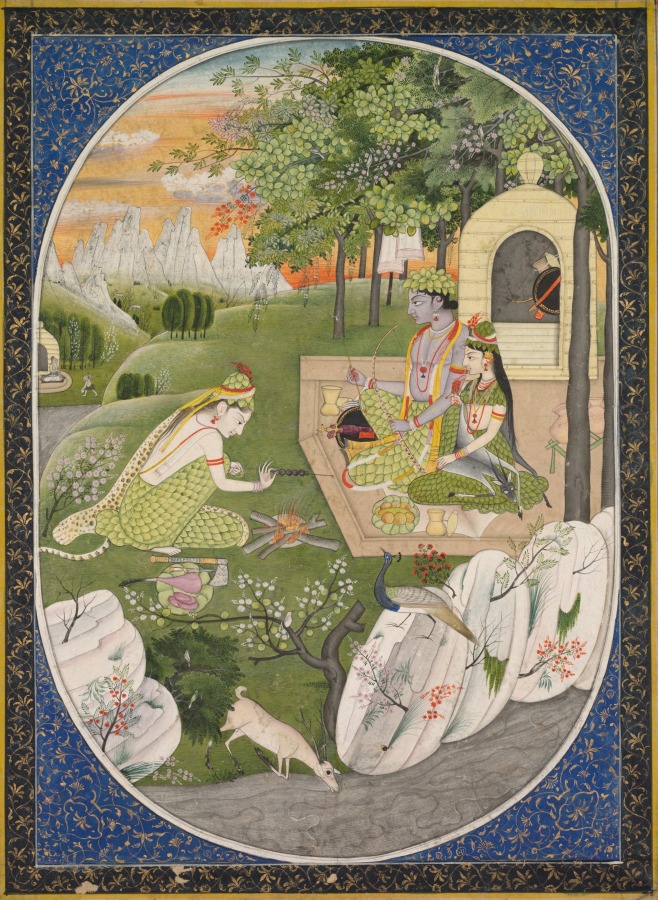
Although banished from their home, Rama, Sita, and Lakshmana enjoy ten years of relative peace in the wilderness. They build a small hut, make clothes of bark cloth, and eat from the bounty of the forest. Lakshmana neatly prepares meat and roasts kabobs over a fire.
The oval format, adopted from European models, suggests this scene was part of an album series. The pale hues and placement of figures in a space that recedes into the background reveal awareness of imperial Mughal paintings. The hilly scenery was likely inspired by the landscape surrounding the Kangra Valley.
The oval format, adopted from European models, suggests this scene was part of an album series. The pale hues and placement of figures in a space that recedes into the background reveal awareness of imperial Mughal paintings. The hilly scenery was likely inspired by the landscape surrounding the Kangra Valley.
Provenance
(C. L. Bharany, Sunder Nagar Market, New Delhi, India, sold to Severance and Greta Millikin) (?–1966); Severance A. [1895–1985] and Greta [Marguerite Steckerl] Millikin [1903–89], Cleveland, OH, given to the Cleveland Museum of Art (1966–1989); The Cleveland Museum of Art, Cleveland, OH (1989–)
Accession Number
1989.332
Medium
Gum tempera, ink, and gold on paper
Dimensions
Painting: 21.5 x 15.1 cm (8 7/16 x 5 15/16 in.); Overall: 23.9 x 17.3 cm (9 7/16 x 6 13/16 in.)
Classification
Painting
Credit Line
Bequest of Mrs. Severance A. Millikin