Description
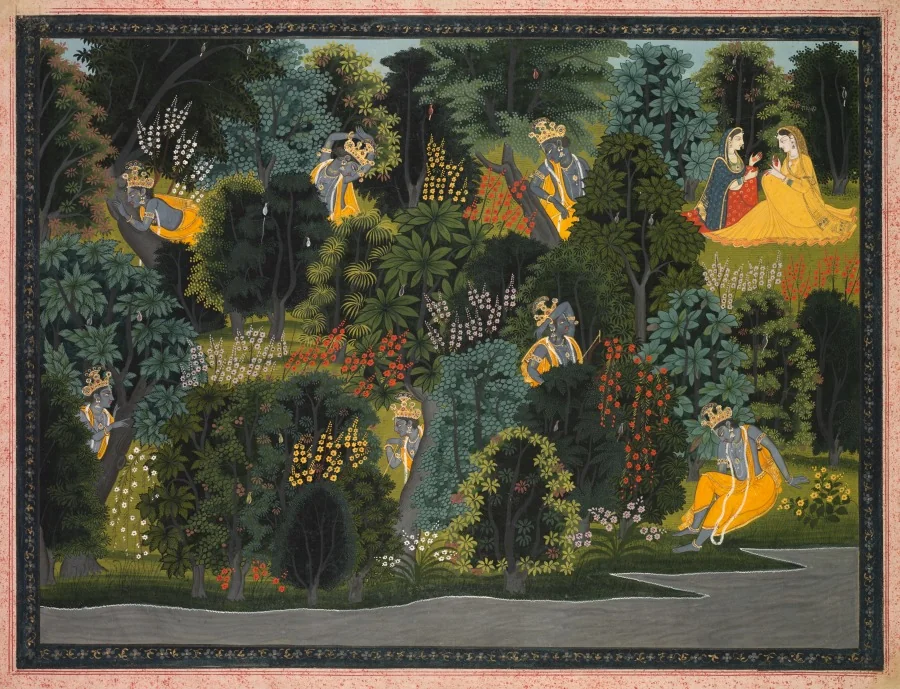
In the lush forests on the banks of India’s Yamuna River, the youthful god Krishna waits to rendezvous with his beloved Radha. The artist has rendered his impatience by showing seven Krishnas, in various attitudes of anxious waiting, as though seeing him over a period of time. Meanwhile Radha, dressed in yellow at top right, confers seemingly endlessly with her confidante, as she tries to decide whether she should meet Krishna for the illicit tryst—she is already married and Krishna is prone to flirting with other girls. This scene is a metaphor for how god waits for us to come to him, while the human devotee frets about the bonds of social norms.
Provenance
Raja of Lambagraon; (Mr. B. R. Sharma, New Delhi, India); Severance A. [1895–1985] and Greta [Marguerite Steckerl] Millikin [1903–1989], Cleveland, OH, given to the Cleveland Museum of Art (?–1989); The Cleveland Museum of Art, Cleveland, OH (1989–)
Accession Number
1989.333
Medium
Gum tempera and gold on paper
Dimensions
Image: 24.1 x 32.4 cm (9 1/2 x 12 3/4 in.); with mat: 40.6 x 53.2 cm (16 x 20 15/16 in.); with borders: 25.6 x 33.8 cm (10 1/16 x 13 5/16 in.)
Classification
Painting
Credit Line
Bequest of Mrs. Severance A. Millikin
Tags
Painting Neoclassical & Romantic (1751–1850) Tempera Gold Leaf Paper Color: Gold
Background & Context
Background Story
Krishna's Longing for Radha from the Gita Govinda of Jayadeva, created c. 1820-25, depicts Krishna's longing for Radha in the richly colored, narrative manner of the Pahari miniature painting tradition. The Gita Govinda by the 12th-century poet Jayadeva is one of the most important works of Sanskrit literature, describing the divine love of Krishna and Radha in lyrical verse that has been one of the most important sources for Indian miniature painting. This illustration of Krishna's longing for Radha represents one of the most poetic subjects in the Gita Govinda, and the c. 1820-25 date places this in the period when Pahari miniature painting was producing some of its most accomplished illustrations of the Gita Govinda.
Cultural Impact
Krishna's Longing for Radha is important in the history of Indian painting because it illustrates one of the most poetic subjects from the Gita Govinda—Jayadeva's 12th-century masterpiece of Sanskrit literature that has been one of the most important sources for Indian miniature painting. The Gita Govinda—describing the divine love of Krishna and Radha in lyrical verse—has inspired some of the most accomplished works in Indian miniature painting, and the c. 1820-25 illustration shows this tradition at its most richly colored and narrative.
Why It Matters
Krishna's Longing for Radha is an anonymous Pahari miniature: Krishna's longing for his beloved Radha from the Gita Govinda rendered in the richly colored, narrative manner of the Indian miniature painting tradition. The c. 1820-25 illustration shows one of the most poetic subjects from Jayadeva's masterpiece at its most richly colored.