Description
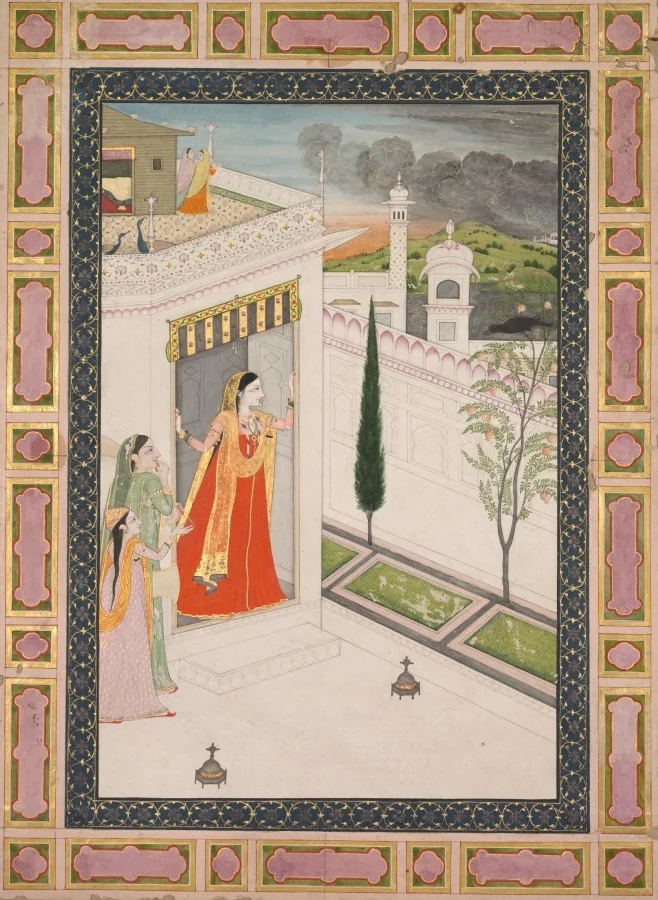
The heroine in the doorway is waiting for her husband to return, but he is delayed, and ominous monsoon clouds gather in the distance. The pomegranate tree in her garden has ripe fruits replete with seeds and bright red juices, suggestive of her fertility, but a crow is perched there. The sound of a crow’s voice is an unlucky omen, and this further compounds her anxiety.
Depictions of tense, relatable situations were made to elicit empathy in the viewer and emotions that heightened the pleasure of viewing and savoring paintings.
Depictions of tense, relatable situations were made to elicit empathy in the viewer and emotions that heightened the pleasure of viewing and savoring paintings.
Provenance
Raja of Lambagraon; B. R. Sharma, New Delhi, 1967; Severance and Greta Millikin, Cleveland (1967 ); Raja of Lambagraon; (B. R. Sharma, New Delhi, 1967); Severance and Greta Millikin, Cleveland, 1967.
Accession Number
1989.337
Medium
Gum tempera and gold on paper
Dimensions
Overall: 21.4 x 14.5 cm (8 7/16 x 5 11/16 in.)
Classification
Painting
Credit Line
Bequest of Mrs. Severance A. Millikin
Tags
Painting Neoclassical & Romantic (1751–1850) Tempera Gold Leaf Paper Color: White
Background & Context
Background Story
Augury of the Crow (Vasakasajja Nayika) from c. 1800 depicts one of the nayikas (heroines) of Indian classical poetry in the richly colored, narrative manner of the Pahari miniature painting tradition. The Vasakasajja nayika—meaning 'one dressed for union'—is one of the eight nayikas (heroine types) classified in Indian classical poetry and aesthetics, representing the heroine who has dressed herself in preparation for meeting her lover. Paintings depicting the nayikas represent one of the most accomplished traditions in Indian miniature painting, combining the personification of poetic types with the rich color and narrative detail that are the hallmarks of the Pahari tradition.
Cultural Impact
Augury of the Crow (Vasakasajja Nayika) is important in the history of Indian painting because it demonstrates the Pahari miniature tradition's personification of the nayikas (heroine types) of Indian classical poetry. The Vasakasajja nayika—one of the eight nayikas classified in Indian classical poetics—represents the heroine dressed for union with her lover, and the c. 1800 painting shows this poetic type at its most richly colored and narrative.
Why It Matters
Augury of the Crow is an anonymous Pahari miniature: the Vasakasajja nayika (heroine dressed for union) depicted in the richly colored narrative manner of the Indian miniature painting tradition. The c. 1800 painting shows the personification of poetic types that is one of the most accomplished traditions in Indian art.