Provenance
Raja Anand Chand, Bilaspur; Severance and Greta Millikin, Cleveland (1967 ); Raja Anand Chand, Bilaspur; (B. R. Sharma, New Delhi); Severance and Greta Millikin, Cleveland, 1967.
Accession Number
1989.339
Medium
Gum tempera, ink, and gold on paper
Dimensions
Overall: 24.3 x 27 cm (9 9/16 x 10 5/8 in.); with borders: 25.1 x 30.5 cm (9 7/8 x 12 in.)
Classification
Painting
Credit Line
Bequest of Mrs. Severance A. Millikin
Tags
Painting Neoclassical & Romantic (1751–1850) Ink Tempera Gold Leaf Paper Color: Yellow
Background & Context
Background Story
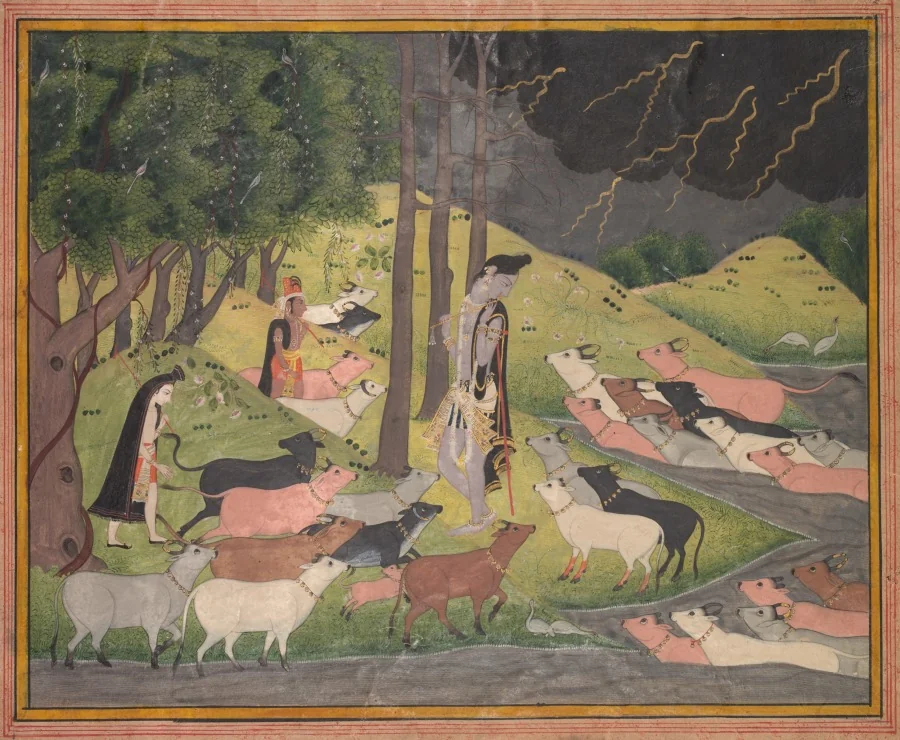
Krishna Summoning the Cows from c. 1780-90 depicts Krishna summoning the cows in the richly colored, narrative manner of the Pahari miniature painting tradition. The image of Krishna as the divine cowherd (Gopala) summoning his cows is one of the most beloved subjects in Hindu art, representing Krishna's role as the protector and guide of his devotees, and paintings depicting this subject represent one of the most accomplished traditions in Indian miniature painting. The c. 1780-90 date places this in the period when Pahari miniature painting was producing some of its most accomplished works illustrating the life of Krishna.
Cultural Impact
Krishna Summoning the Cows is important in the history of Indian painting because it depicts one of the most beloved subjects in Hindu art—Krishna as the divine cowherd summoning his cows—in the richly colored, narrative manner of the Pahari miniature tradition. The image of Krishna summoning the cows—representing Krishna's role as the protector and guide of his devotees—is one of the most beloved subjects in Hindu art, and the c. 1780-90 painting shows this tradition at its most richly colored.
Why It Matters
Krishna Summoning the Cows is an anonymous Pahari miniature: the divine cowherd depicted in the richly colored narrative manner of the Indian miniature painting tradition. The c. 1780-90 painting shows one of the most beloved subjects in Hindu art at its most richly colored.