Description
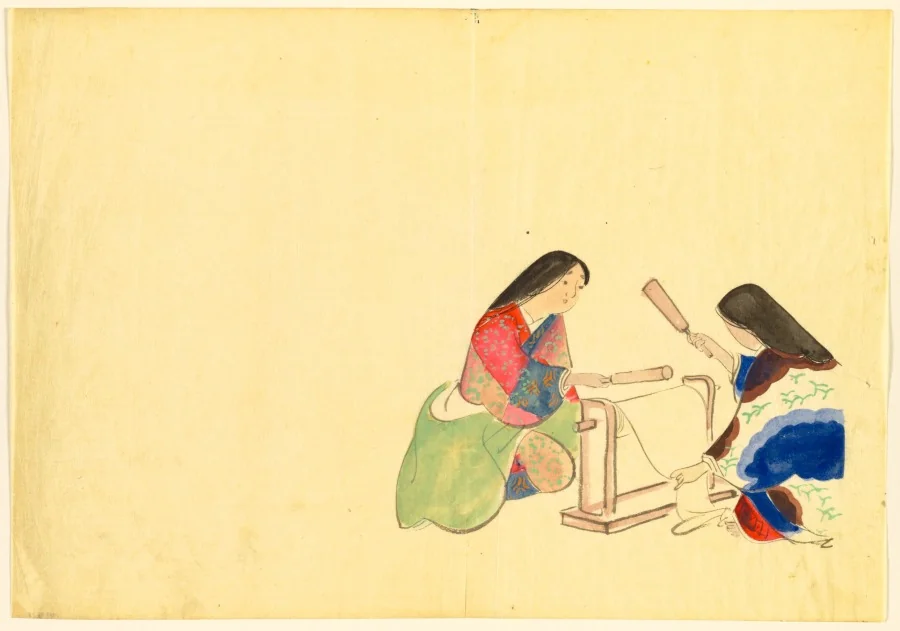
Kamisaka Sekka made preparatory drawings for his Flowers of a Hundred Worlds series on tracing paper with ink and color. The freehand sketches are much looser than the finished, printed compositions.
Provenance
(Yanagi Fine Art Shop, Kyoto, Japan, sold to the Cleveland Museum of Art) (?–1989); The Cleveland Museum of Art, Cleveland, OH (1989–)
Accession Number
1989.85.15
Medium
ink and color on paper
Dimensions
N/A
Classification
Drawing
Credit Line
John L. Severance Fund
Tags
Drawing Early Modern (1901–1950) Ink Paper Japanese Color: Yellow
Background & Context
Background Story
Fulling Silk (Uchiginu) from the Momoyogusa series depicts the ancient craft of fulling—beating newly woven silk cloth with wooden mallets to soften and refine it. This practice, known as uchiginu in Japanese, was both a practical textile process and a poetic subject with deep literary roots. In classical Japanese poetry, the sound of fulling cloth at night became an autumnal motif evoking loneliness and longing, appearing in countless waka from the Heian period. The rhythmic sound of wooden mallets on silk carried across autumn evenings became a symbol of separation and melancholy. Sekka transforms this sound-image into visual form, using Rinpa decorative principles to render the fulling process as pattern and design rather than narrative illustration. Published in 1909, the plate documents a traditional craft that was being transformed by industrial textile production. Mechanical fulling replaced hand methods in Japanese factories, making the sound of hand-fulling increasingly rare in urban areas. Sekka's image operates on multiple levels: as aesthetic object, as cultural record, and as a meditation on the relationship between craft traditions and modernity.
Cultural Impact
The uchiginu subject influenced how textile crafts were understood and preserved in modern Japan. By the early 20th century, traditional textile processes were being romanticized as Japan industrialized, and images like Sekka's contributed to cultural preservation efforts. The poetic associations of fulling silk—its connection to autumn, loneliness, and women's labor—also influenced how Japanese literature and art represented the intersection of domestic work and aesthetic experience.
Why It Matters
Fulling Silk matters because it bridges craft, literature, and visual art in a single image. It demonstrates that practical processes can carry deep cultural and emotional meaning, and that the transformation of such processes through industrialization represents not just technological change but cultural loss. For contemporary audiences, it offers a reminder that the sounds and rhythms of handcraft are part of a society's intangible heritage.