Description
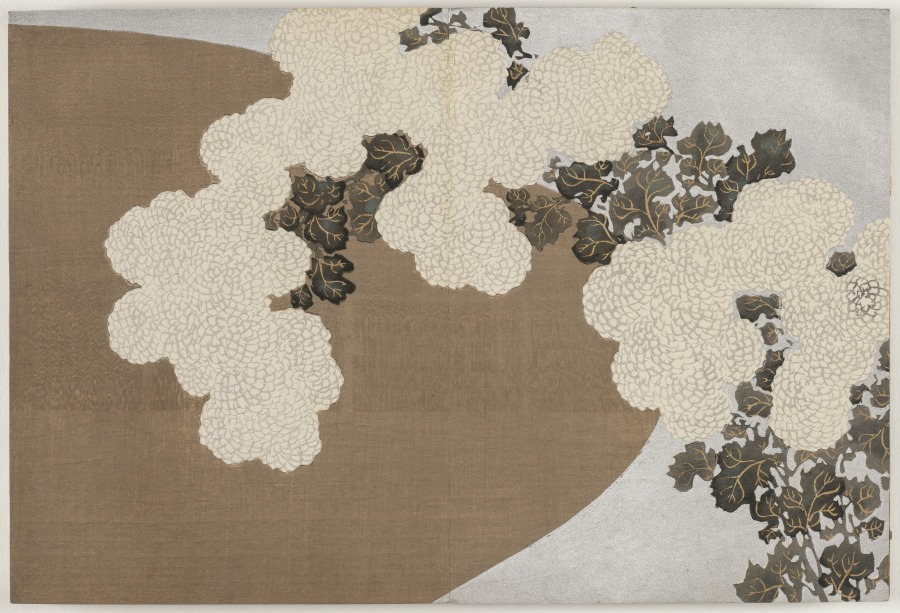
Kamisaka Sekka made preparatory drawings for his Flowers of a Hundred Worlds series on tracing paper with ink and color. The freehand sketches are much looser than the finished, printed compositions.
Provenance
(Yanagi Fine Art Shop, Kyoto, Japan, sold to the Cleveland Museum of Art) (?–1989); The Cleveland Museum of Art, Cleveland, OH (1989–)
Accession Number
1989.85.22
Medium
ink and color on paper
Dimensions
N/A
Classification
Drawing
Credit Line
John L. Severance Fund
Tags
Drawing Early Modern (1901–1950) Ink Paper Japanese Color: Orange
Background & Context
Background Story
Shibaraku from Momoyogusa illustrates the most iconic moment in kabuki theater: the dramatic entrance of the hero who steps onto the hanamichi (flower path) stage extension and delivers the famous cry 'Shibaraku!'—literally 'Wait a moment!'—halting an injustice in progress. This kabuki convention, established by Ichikawa Danjūrō I in the late 17th century, became one of the most recognizable moments in all of Japanese performing arts. The Shibaraku pose—with exaggerated crossed-arm gesture, bold costume, and commanding stage presence—synthesizes all of kabuki's visual principles: mie (dramatic pose), kumadori makeup, and elaborate costuming. Sekka captures this theatrical climax in visual form, translating the kinetic energy of live performance into a static but dynamic composition. By 1909, kabuki was navigating its own modernization crisis: traditional audiences were aging, new theatrical forms competed for attention, and some reformers wanted to Westernize Japanese theater. Sekka's Shibaraku plate asserts the enduring visual power of kabuki convention, presenting it not as relic but as a living design resource.
Cultural Impact
The Shibaraku moment became perhaps the single most reproduced image from kabuki, appearing in ukiyo-e prints, Meiji-era photography, postcards, and eventually film. Sekka's Momoyogusa interpretation influenced how kabuki was visualized in 20th-century design and advertising. The image also shaped international understanding of kabuki—when Western audiences think of kabuki, they often imagine something close to the Shibaraku pose. This plate contributed to that global visual shorthand.
Why It Matters
Shibaraku matters because it demonstrates how performing arts can generate images that outlast the performances themselves. The kabuki convention became a standalone visual icon detachable from its theatrical context, used to signify 'Japaneseness' or 'drama' in contexts far beyond the theater. Sekka's plate is both a celebration of kabuki and a demonstration that live art can survive as visual art, providing a model for how other performing traditions might be preserved through design.