Description
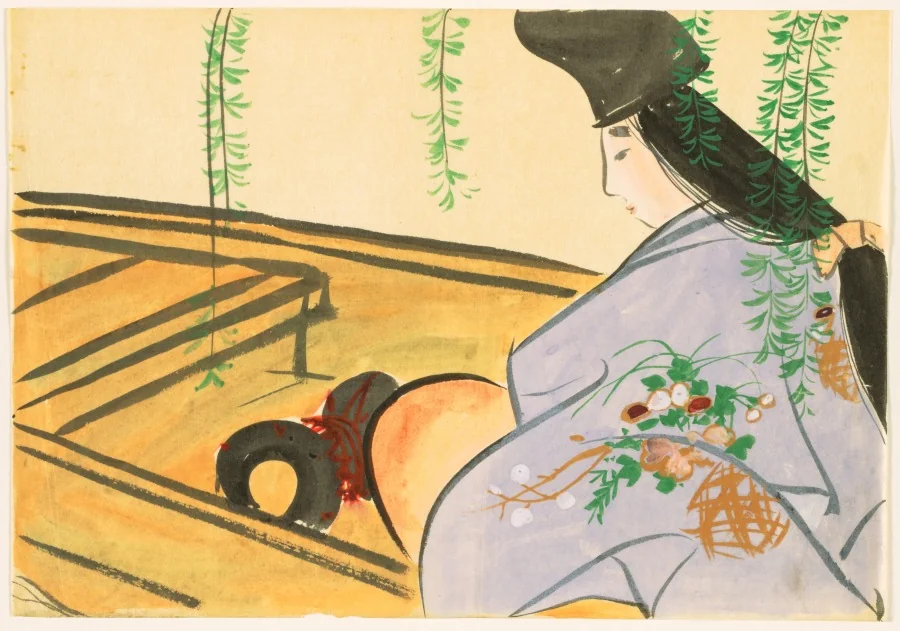
Kamisaka Sekka made preparatory drawings for his Flowers of a Hundred Worlds series on tracing paper with ink and color. The freehand sketches are much looser than the finished, printed compositions.
Provenance
(Yanagi Fine Art Shop, Kyoto, Japan, sold to the Cleveland Museum of Art) (?–1989); The Cleveland Museum of Art, Cleveland, OH (1989–)
Accession Number
1989.85.6
Medium
ink and color on paper
Dimensions
N/A
Classification
Drawing
Credit Line
John L. Severance Fund
Tags
Drawing Early Modern (1901–1950) Ink Paper Japanese Color: Orange Color: White
Background & Context
Background Story
Asazuma in Her Boat (Asazuma-bune) from the Momoyogusa series illustrates a well-known episode from Japanese literary and theatrical tradition. Asazuma was a legendary boatwoman associated with the Tōhoku region whose story appears in various forms across Japanese folklore, Noh, and kabuki. The image of a woman alone in a small boat on water resonated deeply within Japanese visual culture, connecting to a rich tradition of boat imagery from The Tale of Genji scroll paintings through ukiyo-e prints of Yoshitsune and his retainer Benkei crossing the Dan-no-ura strait. The solitary figure on water became a metaphor for existential passage, impermanence, and the journey between worlds. Sekka renders this theme with characteristic Rinpa economy, focusing on the boat's form and the figure's silhouette against water and sky. The composition uses water's reflective surface as a design element, integrating the boat into the broader visual pattern. Published in 1909, the image spoke to audiences who recognized the literary reference while also appreciating the formal beauty of the design.
Cultural Impact
The Asazuma subject contributed to the broader Japanese visual tradition of boat imagery that influenced landscape painting, ukiyo-e, and modern commercial design. The solitary boat on water became a motif used in Japanese tourism imagery, literary book covers, and film imagery throughout the 20th century. Sekka's interpretation, by treating the subject as pure design rather than narrative illustration, influenced how later artists approached literary subjects in visual media.
Why It Matters
Asazuma in Her Boat matters because it demonstrates how literary allusion can be embedded in decorative art without explicit narrative. The image works on two levels simultaneously: as a beautiful composition of boat, figure, and water, and as a reference to a specific story that enriches the viewing experience. This dual functionality—the decorative and the allusive—is central to the Rinpa tradition and offers contemporary artists a model for creating work that rewards multiple levels of engagement.