Description
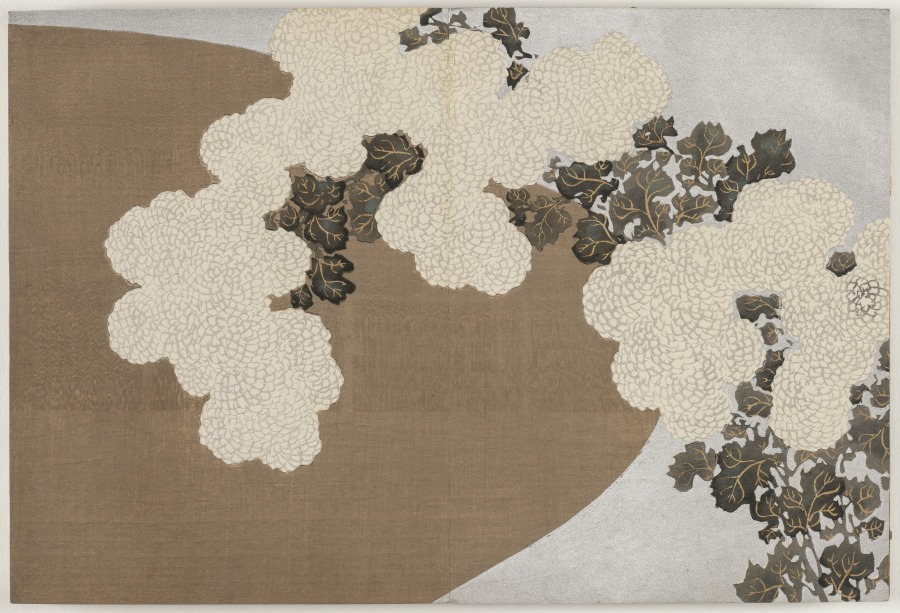
Kamisaka Sekka made preparatory drawings for his Flowers of a Hundred Worlds series on tracing paper with ink and color. The freehand sketches are much looser than the finished, printed compositions.
Provenance
(Yanagi Fine Art Shop, Kyoto, Japan, sold to the Cleveland Museum of Art) (?–1989); The Cleveland Museum of Art, Cleveland, OH (1989–)
Accession Number
1989.85.7
Medium
ink and color on paper
Dimensions
N/A
Classification
Drawing
Credit Line
John L. Severance Fund
Tags
Drawing Early Modern (1901–1950) Ink Paper Japanese Color: Yellow Color: Brown
Background & Context
Background Story
Oxherd (Bokudo) from the Momoyugusa series depicts one of the most philosophically rich subjects in East Asian visual culture. The oxherd—known in Chinese as niuwen and in Japanese as bokudo—appears in Zen Buddhist parables, particularly the famous Ten Ox-Herding Pictures (Jūgyūzu) that chart the stages of spiritual awakening. In this Zen tradition, the ox represents the true self or Buddha-nature, and the herder's journey from seeking the ox to becoming one with it maps the path from ignorance to enlightenment. Sekka's version likely draws on this Zen heritage while transforming it through Rinpa aesthetics. Rather than rendering the ten-stage narrative, Sekka condenses the oxherd into a single decorative image that suggests the entire spiritual journey through visual economy. The ox and herder become design elements, their forms integrated into a composition that balances human and animal, stillness and movement, the domestic and the wild. Published in 1909, this plate appeared during a period when Zen Buddhism was being reinterpreted for modern audiences, both in Japan and increasingly in the West through D.T. Suzuki's influential writings.
Cultural Impact
The oxherd tradition influenced not only Buddhist art but also Modernist abstract art—artists from Brancusi to Franziska zu Reventlow engaged with the ox-herding metaphor. Sekka's Momoyogusa interpretation contributed to the 20th-century reception of Zen visual culture, influencing how these images were used in meditation practice, art therapy, and interfaith dialogue. The simple yet profound image of the herder and ox became one of the most recognizable motifs in global Buddhist visual culture.
Why It Matters
Oxherd matters because it demonstrates how visual art can communicate philosophical ideas without relying on text or explicit instruction. The Ten Ox-Herding Pictures tradition proved that spiritual progress can be mapped visually, and Sekka's single-plate distillation proves that the essence of this mapping can be captured in a single image. For artists working in any tradition, it offers a model for condensing complex ideas into clear visual form.