Description
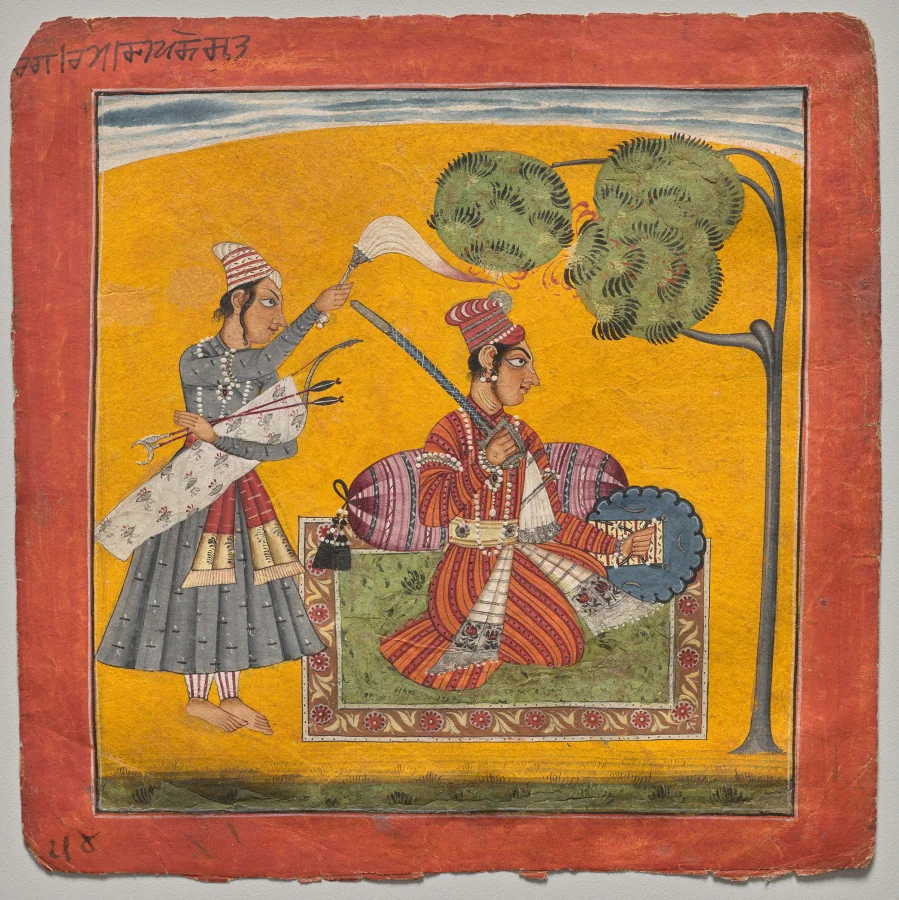
A nobleman is seated on a carpet, attended by a retainer holding a flywhisk.
Provenance
[]
Accession Number
1990.13
Medium
Gum tempera and ink on paper
Dimensions
Overall: 20.3 x 20.3 cm (8 x 8 in.)
Classification
Painting
Credit Line
Mr. and Mrs. William H. Marlatt Fund
Tags
Painting Baroque (1600–1750) Ink Tempera Paper Color: Orange
Background & Context
Background Story
Dipak Raga, One of the Thirty-Six Melodies (Ragamala): Personifying Love from c. 1690 depicts the Dipak Raga—a musical mode associated with fire and passion—in the richly colored, narrative manner of the Indian Ragamala painting tradition. The Ragamala (garland of ragas) is a series of paintings that personify the musical modes (ragas) of Indian classical music, and the Dipak Raga is associated with fire, passion, and the heat of love. Paintings depicting the Ragamala represent one of the most accomplished traditions in Indian miniature painting, combining the personification of musical modes with the rich color and narrative detail that are the hallmarks of the tradition.
Cultural Impact
Dipak Raga is important in the history of Indian painting because it demonstrates the Ragamala tradition of personifying the musical modes (ragas) of Indian classical music in the richly colored, narrative manner of Indian miniature painting. The Ragamala tradition—combining the personification of musical modes with the rich color and narrative detail of Indian miniature painting—is one of the most accomplished traditions in Indian art, and the c. 1690 painting shows the Dipak Raga—one of the most passionate ragas—at its most richly colored.
Why It Matters
Dipak Raga is an anonymous Indian miniature from a Ragamala series: the musical mode of fire and passion personified in the richly colored manner of the Indian miniature painting tradition. The c. 1690 painting shows the Ragamala tradition—one of the most accomplished traditions in Indian art—at its most richly colored.