Description
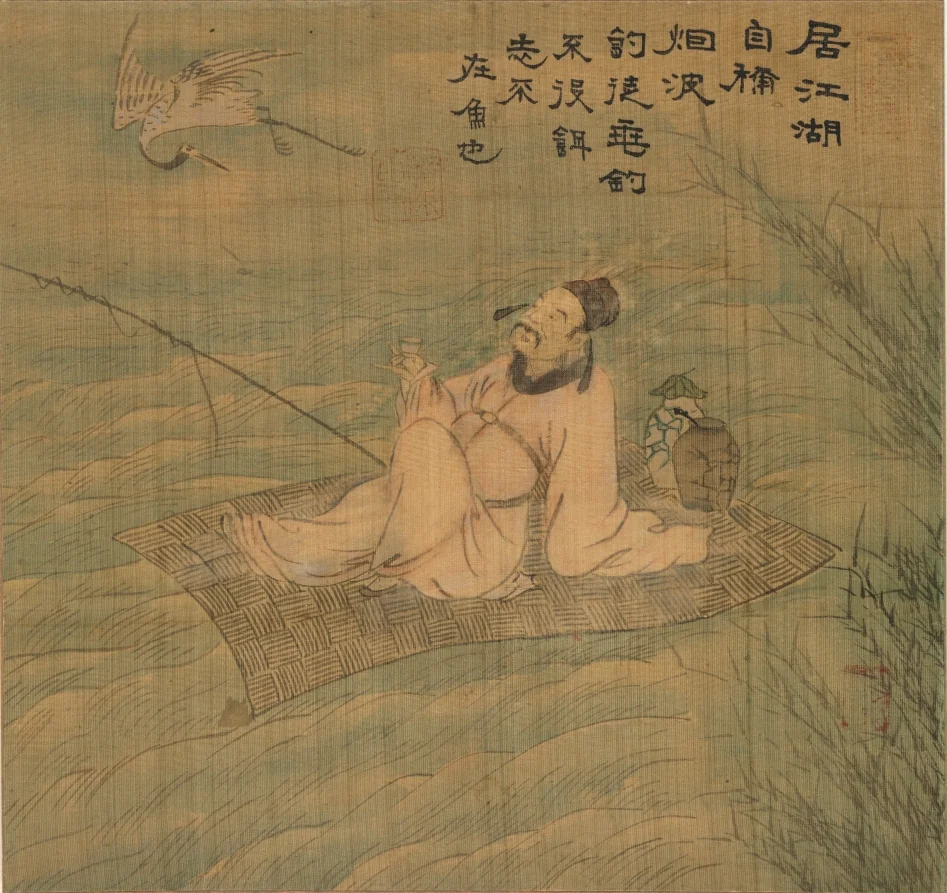
This album leaf depicts the 8th-century Chinese official and Daoist scholar Zhang Zhihe sitting on a raft buffeted by waves. He drinks wine from a small cup, and gazes up at a crane flying above him. Behind him are two large jars, one covered with an overturned lotus leaf. The handle of a ladle emerges from the other. His fishing rod is balanced at his side, but its line is twisted uselessly. Based on its iconography, the painting is likely modeled after an image from an illustrated woodblock edition of the Chinese text Liexian Zuan (Biographies of Exemplary Immortals). The biographical inscription above him reads, "he is a recluse among the rivers and lakes. He calls himself ‘Fishing Disciple Amidst Mists and Waves.’ He is always fishing without bait for Zhi has no need for fish." A rectangular seal in relief appears to the right of the inscription, while a square seal in relief appears to the left. Neither is legible.
Provenance
[]
Accession Number
1990.70
Medium
album leaf from a set; ink and color on silk
Dimensions
Overall: 22.5 x 24 cm (8 7/8 x 9 7/16 in.)
Classification
Painting
Credit Line
John L. Severance Fund
Tags
Painting Neoclassical & Romantic (1751–1850) Ink Silk Painting Color: Orange Color: Gold
Background & Context
Background Story
Poet Fisherman from the 1800s depicts a poet fisherman in the elegantly composed, atmospheric manner of Japanese literati painting. The subject of the poet fisherman was one of the most important subjects in Japanese literati painting, representing the ideal of the scholarly recluse who has withdrawn from worldly concerns to live in harmony with nature. The fisherman-poet represents the literati ideal of finding artistic and spiritual fulfillment in the simple life close to nature, and paintings of this subject represent one of the most accomplished traditions in Japanese literati painting.
Cultural Impact
Poet Fisherman is important in the history of Japanese painting because it depicts the poet fisherman—one of the most important subjects in Japanese literati painting—in the elegantly composed, atmospheric manner of the Japanese literati tradition. The poet fisherman—representing the ideal of the scholarly recluse living in harmony with nature—was one of the most important subjects in Japanese literati painting, and the 1800s painting shows this tradition at its most elegantly composed.
Why It Matters
Poet Fisherman is an anonymous Japanese literati painting: the scholarly recluse rendered in the elegantly composed, atmospheric manner of the Japanese painting tradition. The 1800s painting shows the literati ideal of retreat from worldly concerns that is one of the most important subjects in Japanese painting.