Description
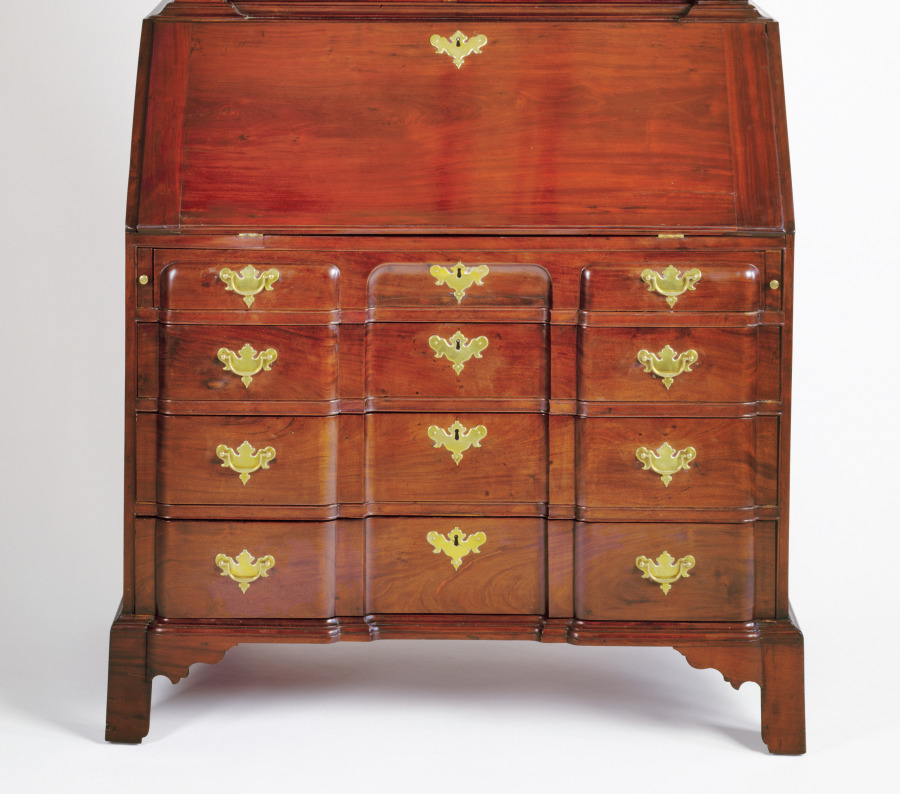
During the 1700s, a desk and bookcase, sometimes called a bureau in early inventories, was among the largest and most expensive pieces of furniture in a household. Their owners were chiefly businessmen and community leaders, and because of their function as repositories for personal letters and documents, they were usually placed downstairs in a back parlor or hall. A desk and bookcase consisted of two parts: usually a slant-top desk below and a cabinet above that sat within moldings applied to the desktop to hold it in place. The form often included elements derived from contemporary architecture. Like much New England furniture of the later 1700s, the lower section of this example is block-fronted, in which the profile recedes in the center and protrudes at either side. Though some European precedents can be found for block fronting, this type of cabinetry was clearly more popular in America than anywhere else.
Provenance
Col. Christopher Toppan (1735-1818), Hampton, New Hamsphire; his son Edmund Toppan (1777-1857); his daughter Sarah Jane Parker Toppan (b. 1822) who married Rev. Samuel J. Spalding, Newburyport, Massachusetts; their granddaughter Helen Chapin Hitchcock (Mrs. Lawrence).
Accession Number
1990.96.a
Medium
mahogany and pine, brass hardware, gilding
Dimensions
Overall: 241.9 x 106 x 56.5 cm (95 1/4 x 41 3/4 x 22 1/4 in.)
Classification
Furniture and woodwork
Credit Line
Bequest of Mrs. Lawrence Hitchcock