
Description
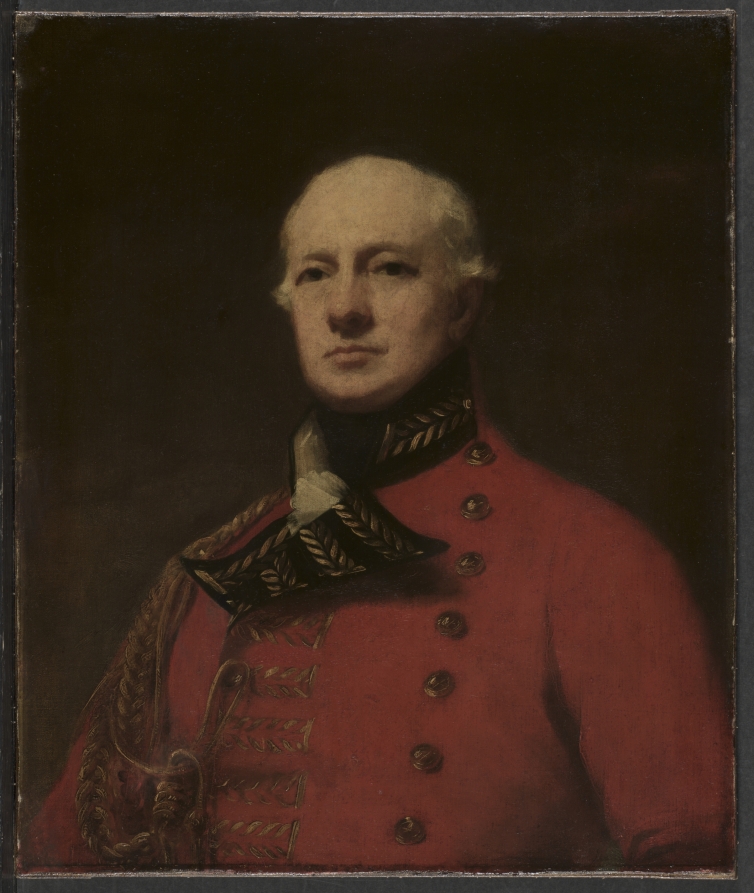
Henry Raeburn created this likeness of fellow Edinburgh native Hugh Hope before Hope departed for India, where he worked as a civil servant for the renowned East India Company (a British joint-stock company founded in 1600 to trade in the Indian Ocean). This painting hung in the drawing room of Hope’s estate, Pinkie House in Scotland, until 1928. Although greatly influenced by his English predecessor Joshua Reynolds, Raeburn worked in a looser style, more like the work of his younger contemporary Thomas Lawrence. This portrait is painted directly on the canvas without any preliminary drawing, giving it an informal, spontaneous air.
Provenance
the sitter (1782-1822); by inheritance to Sir Alexander Hope, Pinkie House, Scotland (sale: Sotheby's, London, 16 May, 1928, Lot B); I. D. Levy (1930); (Knoedler); Jane Taft Ingalls [1874-1962], Cleveland, OH (1945); David S. Ingalls, Sr. [1899-1985], Cleveland, OH (1945-1985); Francis W. Ingalls; The Cleveland Museum of Art, Cleveland, OH (1991-)
Accession Number
1991.133
Medium
oil on canvas
Dimensions
Framed: 94.5 x 82 x 8 cm (37 3/16 x 32 5/16 x 3 1/8 in.); Unframed: 75 x 61 cm (29 1/2 x 24 in.)
Classification
Painting
Credit Line
Gift in honor of Jane Taft Ingalls on the occasion of the Museum's Seventy-fifth Anniversary
Tags
Painting Neoclassical & Romantic (1751–1850) Oil Painting Canvas Scottish Color: Gold
Background & Context
Background Story
Henry Raeburn (1756-1823) was a Scottish painter known for the powerfully composed, precisely observed portraits that make him one of the most important portrait painters of the British tradition. Portrait of Hugh Hope from c. 1810 depicts Hugh Hope in the powerfully composed, precisely observed manner that distinguishes Raeburn's best portrait work from the more general portraiture of his contemporaries. Raeburn was known for his powerfully composed, precisely observed portraits that capture the personality and presence of his sitters with remarkable directness, and his work represents one of the most important traditions in British portrait painting.
Cultural Impact
Portrait of Hugh Hope is important in the history of British portrait painting because it demonstrates the powerfully composed, precisely observed manner that Raeburn brought to portraiture as one of the most important portrait painters of the British tradition. Raeburn's powerfully composed, precisely observed portraits—capturing the personality and presence of his sitters with remarkable directness—represent one of the most important traditions in British portrait painting, and the c. 1810 portrait shows this tradition at its most powerfully composed.
Why It Matters
Portrait of Hugh Hope is Raeburn's powerfully composed Scottish portrait: Hugh Hope depicted in the precisely observed manner of one of the most important portrait painters of the British tradition. The c. 1810 portrait shows the powerful composition and precise observation that make Raeburn one of the most important portrait painters.
![Saint Bernard and Saint Catherine of Alexandria with the Virgin of the Annunciation [right panel]](https://api.nga.gov/iiif/e6890364-4d99-4684-a62b-5060ee3c3446/full/400,/0/default.jpg)