Description
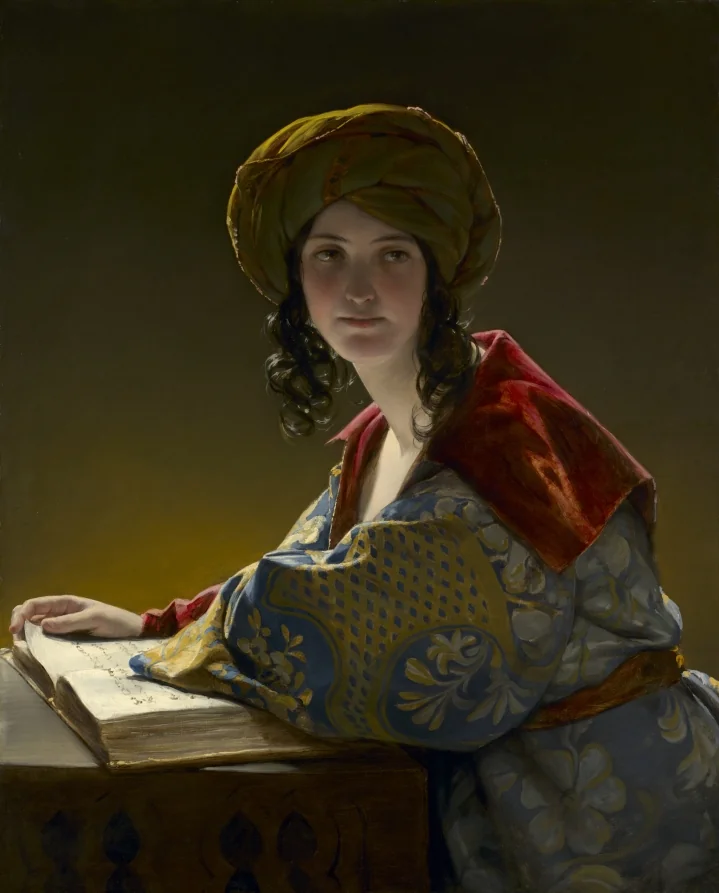
Although the artist provocatively titled this painting Young Eastern Woman, it is obvious that the model is not Asian, but merely wears a Turkish costume. The rich fabrics and glowing light create an exotic atmosphere, revealing a Western fascination with "Oriental" images and themes.
Provenance
The Cleveland Museum of Art, Cleveland, Ohio (1991-); (Galerie Sanct Lucas, Vienna, sold to the Cleveland Museum of Art) (1971-1991); Heirs of Franz Wertheim, United States, sold to the Galerie Sanct Lucas (Probably 1883-1971); Baron Franz Wertheim [1814-1883], Vienna, by descent to his heirs (Date description:); Löscher, Vienna (1871-); (P. Kaeser, Vienna, Fellner sale, Dec. 14-15, 1871, lot 9, as "Die Morgenländerin," sold to Löscher) (1871); Jakob Fellner, Vienna (c. 1852-1871); Mathias Feldmüller (the Younger), Vienna, sold to Jakob Fellne (1838-c. 1852)
Accession Number
1991.163
Medium
oil on fabric
Dimensions
Framed: 106.5 x 90.5 x 9 cm (41 15/16 x 35 5/8 x 3 9/16 in.); Unframed: 88.5 x 71.5 cm (34 13/16 x 28 1/8 in.)
Classification
Painting
Credit Line
Mr. and Mrs. William H. Marlatt Fund
Tags
Painting Neoclassical & Romantic (1751–1850) Oil Painting Austrian Color: Yellow
Background & Context
Background Story
Friedrich Amerling (1803-1887) was an Austrian painter known for the elegantly composed, precisely observed portraits that make him one of the most accomplished portrait painters of the 19th-century Austrian tradition. The Young Eastern Woman from 1838 depicts a young eastern woman in the elegantly composed, precisely observed manner that distinguishes Amerling's best portrait work from the more general portraiture of his contemporaries. Amerling was one of the most important portrait painters of the Austrian Biedermeier period, known for his elegantly composed, precisely observed portraits that capture the personality and beauty of his sitters with remarkable precision.
Cultural Impact
The Young Eastern Woman is important in the history of Austrian portrait painting because it demonstrates the elegantly composed, precisely observed manner that Amerling brought to portraiture as one of the most accomplished portrait painters of the 19th-century Austrian tradition. Amerling's elegantly composed, precisely observed portraits—capturing the personality and beauty of his sitters with remarkable precision—represent one of the most accomplished traditions in Austrian Biedermeier portrait painting, and the 1838 portrait shows this tradition at its most elegantly composed.
Why It Matters
The Young Eastern Woman is Amerling's elegantly composed Austrian portrait: a young eastern woman depicted in the precisely observed manner of one of the most accomplished portrait painters of the Austrian Biedermeier tradition. The 1838 portrait shows the elegant composition and precise observation that make Amerling one of the most accomplished Austrian portrait painters.
![Saint Bernard and Saint Catherine of Alexandria with the Virgin of the Annunciation [right panel]](https://api.nga.gov/iiif/e6890364-4d99-4684-a62b-5060ee3c3446/full/400,/0/default.jpg)