Description
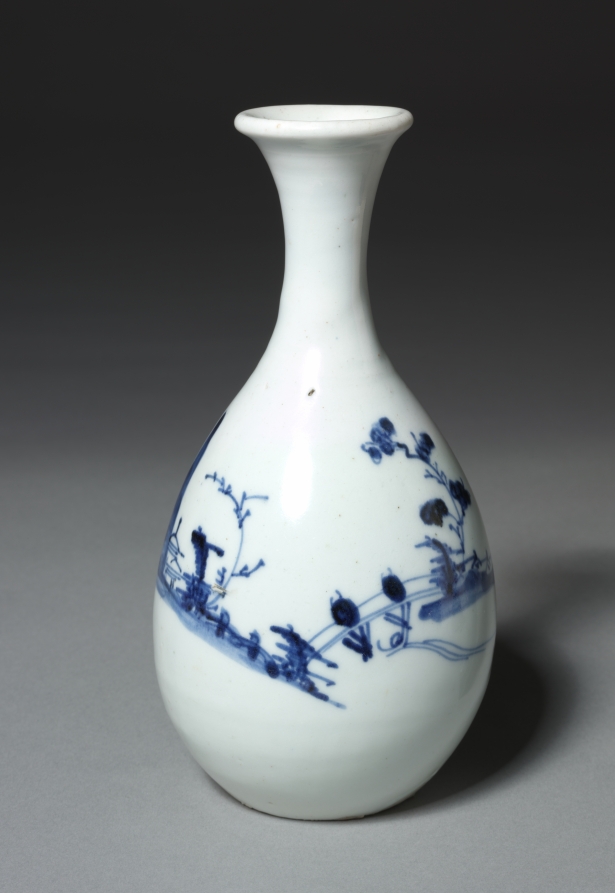
When the late 16th-century shogun (military ruler) of Japan, Toyotomi Hideyoshi, invaded Korea in 1593, and then again in 1597, he made several momentous discoveries which were to change the course of Japanese cultural history. Hideyoshi's troops reported the existence of a sophisticated ceramic industry using large, multichambered kilns to produce high-fired porcelain wares. Since this technology did not exist in Japan, Hideyoshi ordered the resettlement of skilled potters in Japan. Not long thereafter this new kiln technology transformed tea taste and ceramic art in Japan. Subsequently, Korean potters uncovered for the first time in Japan the kaolin deposits fundamental to high-fired porcelain production. So beginning in the mid-1600s, the earliest white Japanese porcelains appeared, produced by Korean potters who transmitted traditional Korean ceramic shapes and surface decoration to their fellow Japanese workers. This small sake flask is a second generation example of that heritage and illustrates a fundamental cultural linkage between Korean and Japanese art.
Provenance
[]
Accession Number
1992.117
Medium
porcelain with underglaze blue (Hizen ware, Arita type, Imari style)
Dimensions
Diameter: 10.2 cm (4 in.); Overall: 20 cm (7 7/8 in.)
Classification
Ceramic
Credit Line
The Severance and Greta Millikin Purchase Fund