Description
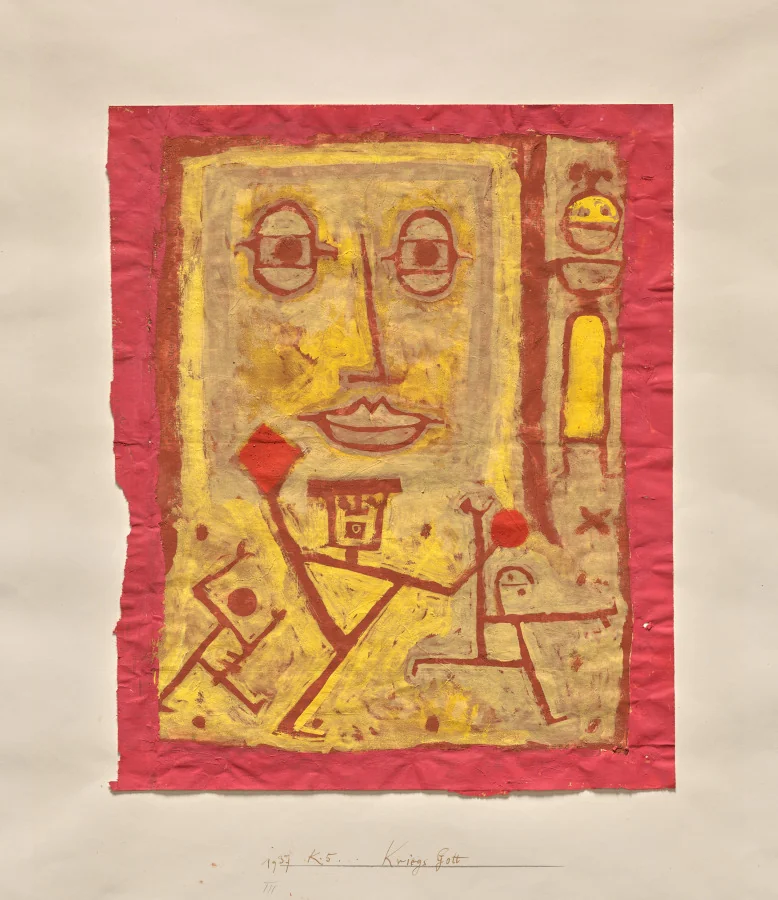
This drawing belongs to a series of large format works with bold colors, thick painterly lines, and pictograph formations that Paul Klee created late in his career. The period during which they were made was marked by anxiety for the artist, as political turmoil grew in Europe during the 1930s. To suggest this experience, Klee painted on a sheet of newspaper, allowing the printed text to intermingle with his own sign-like marks. The article visible here, for example, discusses the Spanish civil war. The figures that dominate the work more subtly suggest this crisis, including a large face with heavy eyelids and an enigmatic smile depicted in layers of yellow paint and several dancing or running figures in the foreground delineated by areas left unpainted.
Provenance
(Galerie Jeanne Bucher-Myrbor, Paris, sold to Lockwood Thompson) (September 14, 1938); Lockwood Thompson [1901-1992], Cleveland, OH, bequest to the Cleveland Museum of Art, Cleveland, OH (1938-1992); Cleveland Museum of Art, Cleveland, OH (1992-)
Accession Number
1992.278
Medium
Gouache and tempera
Dimensions
Sheet: 35.2 x 29 cm (13 7/8 x 11 7/16 in.); Secondary Support: 64.6 x 49.3 cm (25 7/16 x 19 7/16 in.)
Classification
Drawing
Credit Line
Bequest of Lockwood Thompson
Tags
Color: Red Color: Gold
Background & Context
Background Story
Paul Klee (1879–1940), the Swiss-German artist whose work defies easy categorization, created "God of War" in 1937, a year of profound personal and political crisis. Klee had been dismissed from his teaching position at the Düsseldorf Academy by the Nazi regime in 1933, his work was included in the infamous "Degenerate Art" exhibition in 1937, and he was diagnosed with the scleroderma that would end his life three years later. "God of War" responds to this context with characteristic Klee subtlety—not a literal depiction of battle but a symbolic representation of the forces of destruction.
Executed in gouache and tempera on paper, the composition presents a schematic, almost childlike figure that evokes a primitive idol or totem. The "god" is assembled from geometric components—a rectangular body, a circular head, linear appendages—in what appears to be a loose architectural structure. The colors are subdued: earth tones, muted blues, and gray, with accents of red that suggest violence or warning. Klee's distinctive linework guides the eye through the composition, creating a sense of precarious balance.
1937 was a devastating year for modern art in Germany. The Nazi regime confiscated over 16,000 works of "degenerate" art from museums, including Klee's. "God of War" can be read as Klee's response to the rise of fascism—a depiction of the abstract, irrational forces of destruction that were consuming Europe. Yet true to Klee's artistic philosophy, the painting avoids propagandistic directness. Instead, it operates through symbol and metaphor, creating an image that disturbs through its enigmatic quality rather than through explicit horror. It stands as a testament to art's capacity to resist tyranny through imaginative freedom.
Cultural Impact
Klee's late work, produced under the shadow of Nazi persecution and terminal illness, represents one of modern art's most courageous bodies of work. "God of War" demonstrates how abstract, symbolic imagery could address the overwhelming political reality of the 1930s without descending into mere propaganda.
Why It Matters
Created in the same year Klee's work was denounced as "degenerate" by the Nazi regime, "God of War" transforms personal and political crisis into haunting visual poetry. It shows art's power to confront the darkest historical forces through imaginative transformation rather than direct representation.