Description
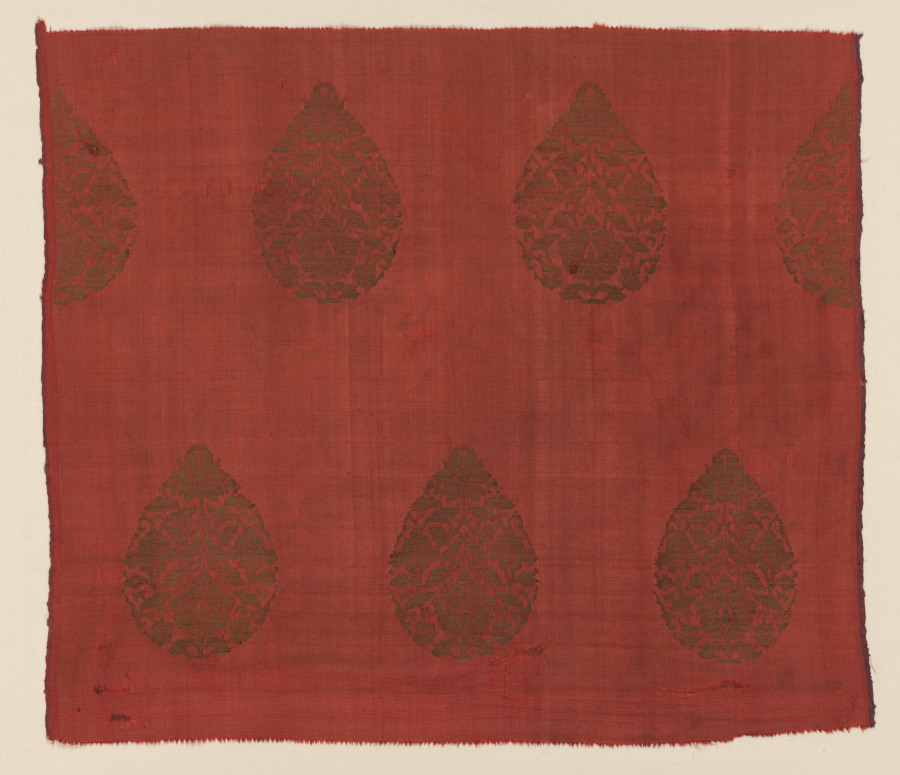
The tradition of brocade weaving in northern China continued after the Mongol conquest. However, the arrival of eastern Iranian craftsmen affected both the design and the structure of the brocades: patterns became symmetrical and paired warps replaced single warps. Both of these modifications can be observed in this example. At the same time, however, the Jin tradition of floating foundation wefts across the back sides of the brocaded areas continued. Brocades such as this may have been woven in Hongzhou (in Hebei province), where weavers from both western Asia and from the former Jin capital, Bianjing, are known to have worked together.
Provenance
(Dr. Friedrich Spuhler, Berlin, Germany, sold to the Cleveland Museum of Art) (?–1994); The Cleveland Museum of Art, Cleveland, OH (1994–)
Accession Number
1994.293
Medium
Silk: tabby, brocaded; gold thread
Dimensions
Overall: 58.4 x 67 cm (23 x 26 3/8 in.); Mounted: 68.6 x 77.5 cm (27 x 30 1/2 in.)
Classification
Textile
Credit Line
John L. Severance Fund