Description
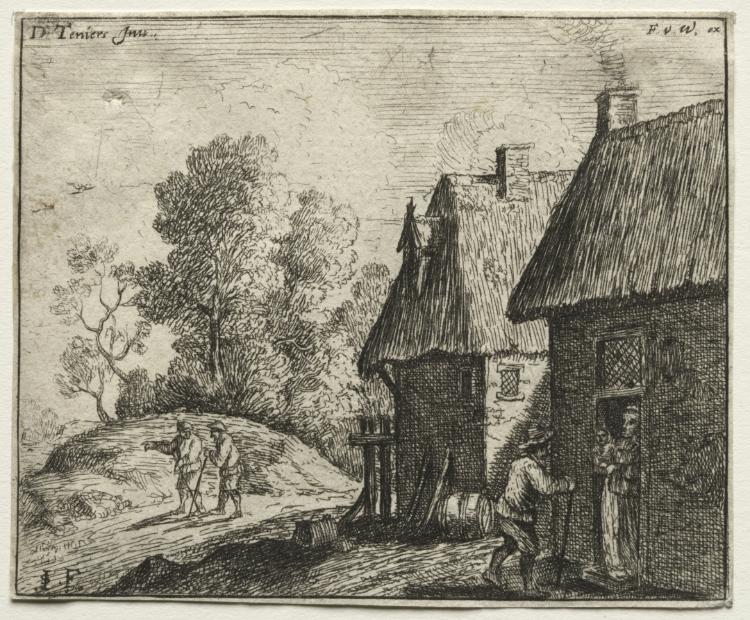
Before a rustic inn, a group of villagers converse, embrace, and dance to a bagpiper’s tune. Teniers was one of many Netherlandish artists whose paintings celebrate the joys of country life. These delicately painted works were created primarily for an elite urban audience nostalgic for a simpler existence.
Provenance
The Cleveland Museum of Art, Cleveland, Ohio (1996-); Frances W. Ingalls [1926-1996], Cleveland, OH, given to the Cleveland Museum of Art (1962-1996); Jane Taft Ingalls [1874-1962], Cleveland, OH, by descent to her daughter-in-law, Frances W. Ingalls (1949-1962); Rosenberg & Stiebel, New York, NY, sold to Jane Taft Ingalls (1949); Baron Louis de Rothschild [1882-1955], East Barnard, VT, sold to Rosenberg & Stiebel (1946-1949); In possession of the United States Forces in Austria (USFA), restituted to Louis de Rothschild (1945-1946); In possession of the Nazis; selected by Hitler for the Führermuseum, Linz (1938-1945); Baron Louis de Rothschild [1882-1955], Vienna, confiscated by the Nazis (Probably 1911-1938); Baron Albert de Rothschild [1844- 1911], Vienna, by descent to his son, Baron Louis de Rothschild (Probably until 1911)
Accession Number
1996.271
Medium
oil on wood
Dimensions
Framed: 69 x 96.5 x 8 cm (27 3/16 x 38 x 3 1/8 in.); Unframed: 49 x 78 cm (19 5/16 x 30 11/16 in.)
Classification
Painting
Credit Line
Gift of the Frances W. Ingalls Trust
Tags
Painting Baroque (1600–1750) Oil Painting Flemish Color: Gray
Background & Context
Background Story
Landscape with Peasants Dancing combines the elder Teniers' interest in peasant genre with the Flemish landscape tradition, placing the dancing figures within a carefully observed rural setting that includes trees, buildings, and the characteristic flat terrain of the Flemish countryside. The dancing peasants provide the narrative and figurative interest, but the landscape provides the spatial and atmospheric context that makes the scene feel like a specific place rather than a stage set. The wood panel support gives the landscape the warm luminosity and fine detail that distinguishes Flemish painting on panel from painting on canvas.
Cultural Impact
The combination of landscape and peasant genre was a Flemish specialty that the Teniers family developed more effectively than any other dynasty of painters. The elder Teniers' version is less polished than his son's, but the landscape element is more prominent and more convincingly observed, suggesting that his interest in the natural world was as genuine as his interest in the social world of the peasants who inhabit it.
Why It Matters
Landscape with Peasants Dancing is the elder Teniers combining his two primary interests: the landscape is not just a backdrop for the dancers but a convincingly observed countryside, and the dancers are not just staffage but genuinely engaged peasants. The result is a painting where landscape and genre support each other rather than competing for attention.