Description
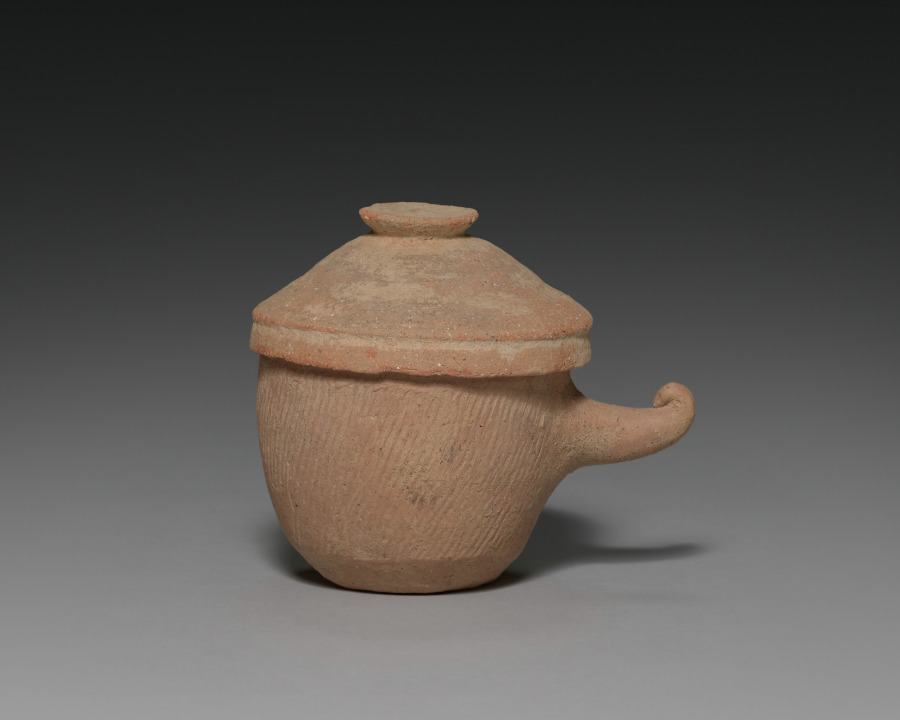
This type of pottery vessel was a product of closed kilns built on hillsides, which became widely used in Korea during the Three Kingdoms period. Its low-fired red surface indicates the various steps in its fabrication. First, coils of clay were layered on top of one another and pinched together to form the wall of the pot. Then wood mallets with carved surfaces pounded these walls simultaneously, inside and out, merging and thinning the clay bands. Thus the impressed designs visible on both the inner and outer surfaces were functional as well as decorative.
Provenance
Keum Ja Kang, New York, NY (?-1981); (Kang Collection, New York, NY, given to the Cleveland Museum of Art) (1981-1997); The Cleveland Museum of Art, Cleveland, OH (March 4, 1997-)
Accession Number
1997.21
Medium
red earthenware with impressed designs and applied red slip
Dimensions
Overall: 10.8 cm (4 1/4 in.); 9.1 cm (3 9/16 in.)
Classification
Ceramic
Credit Line
Gift of the John D. Proctor Foundation