Description
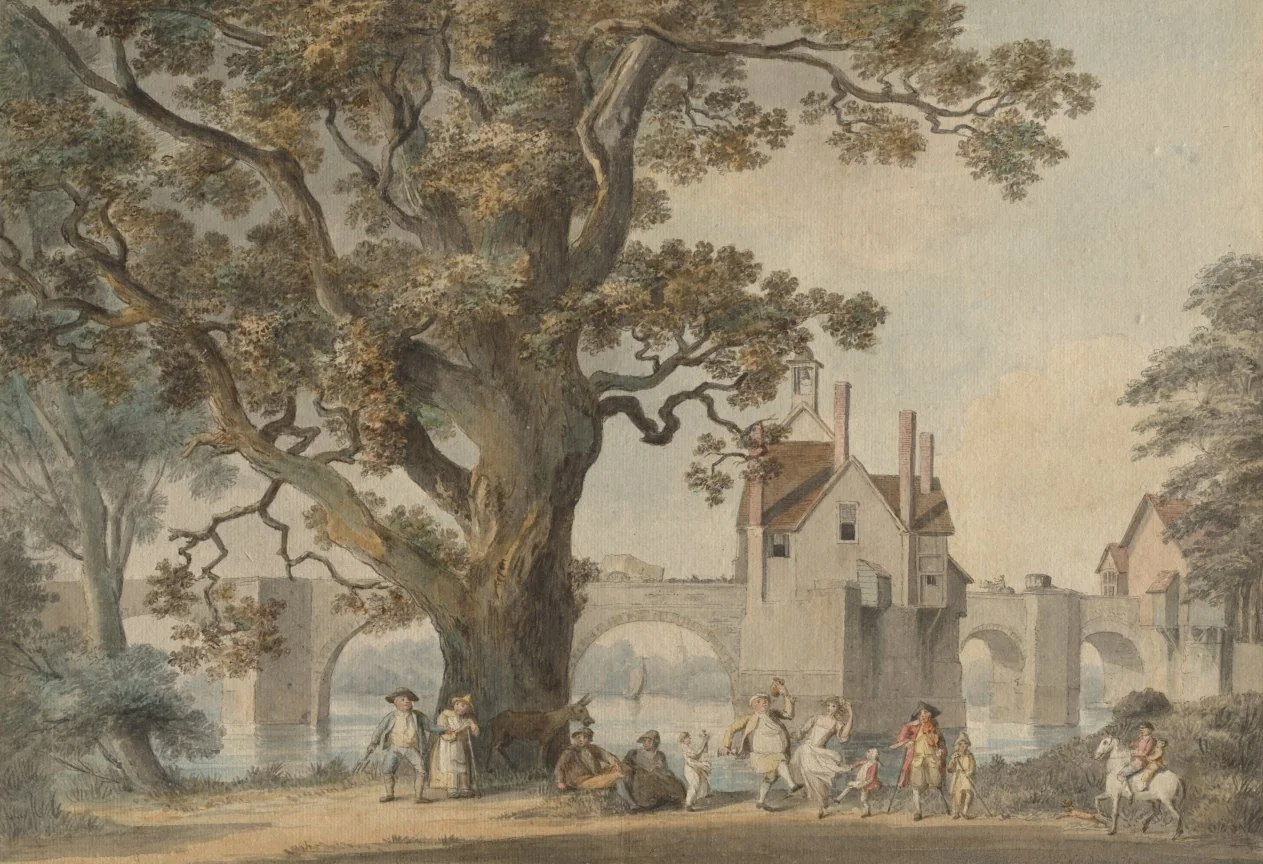
The medium of watercolor has a richer tradition in England than almost any other country, and its rise in importance was closely connected to the development of landscape painting. Paul Sandby was among the first British artists to produce a substantial body of landscape watercolors. Early in his career, Sandby worked as a mapmaker, surveying the Highlands in Scotland while working for the government. His mature work combines topographical accuracy with picturesqe compositions and carefully observed figure groups. This watercolor shows a gated medieval bridge across the River Severa near the town of Bridgenorth, in western England, near Wales. Sandby depicted the subject several times in both watercolors and prints. Here, the rustic merrymakers dancing to a fiddler's music add a social dimension to the scene.
Provenance
Mr. and Mrs. J. King Rosendale, Shaker Heights, OH, given to The Cleveland Museum of Art, Cleveland, OH (?–1997); The Cleveland Museum of Art, Cleveland, OH (June 2, 1997–)
Accession Number
1997.69
Medium
watercolor over graphite
Dimensions
Sheet: 35.5 x 51.7 cm (14 x 20 3/8 in.); Secondary Support: 43 x 57.2 cm (16 15/16 x 22 1/2 in.)
Classification
Drawing
Credit Line
Gift of Mr. and Mrs. J. King Rosendale in honor of Beatrice R. Grubb
Tags
Drawing Neoclassical & Romantic (1751–1850) Watercolor Graphite & Pencil Color: Brown Color: White
Background & Context
Background Story
Bridgenorth, Shropshire from c. 1790 depicts the town of Bridgenorth in Shropshire in the precisely observed, atmospherically composed manner of the British topographical watercolor tradition. Bridgenorth with its dramatic hilltop castle and picturesque bridge over the River Severn was one of the most painted towns in 18th-century Britain, and topographical watercolors depicting English towns and landscapes represent one of the most accomplished traditions in British painting. The c. 1790 date places this in the golden age of British topographical watercolor painting.
Cultural Impact
Bridgenorth, Shropshire is important in the history of British painting because it demonstrates the precisely observed, atmospherically composed manner of the British topographical watercolor tradition as applied to one of the most painted towns in 18th-century Britain. Topographical watercolors depicting English towns and landscapes with precision and atmosphere represent one of the most accomplished traditions in British painting, and the c. 1790 watercolor shows this tradition at its most precisely observed.
Why It Matters
Bridgenorth, Shropshire is an anonymous British topographical watercolor: the town of Bridgenorth rendered in the atmospherically composed manner of the British topographical watercolor tradition. The c. 1790 watercolor shows one of the most painted towns in 18th-century Britain at its most precisely observed.