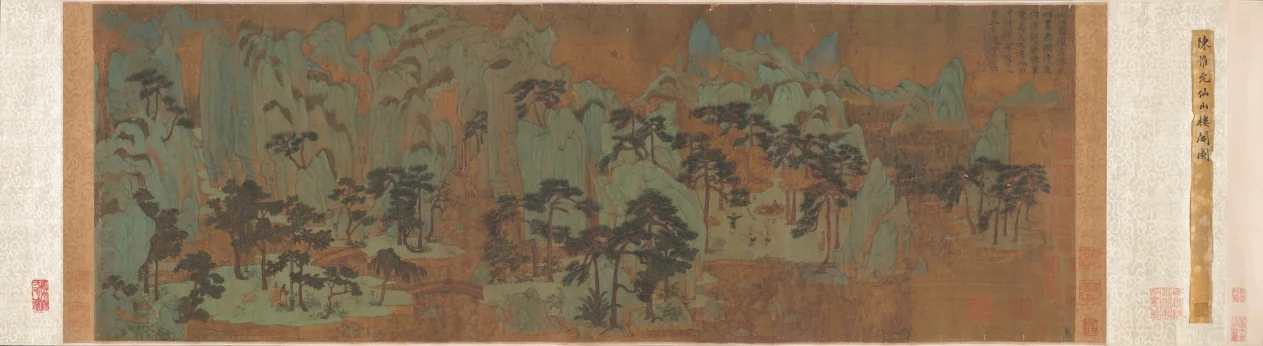
Description
The landscape in deep green tones offers a view into a secluded mountain valley, populated by ancient figures surrounded by deer and cranes, all under high pine trees. A red-robed immortal in the air steers his crane toward the paradise land.
This idyllic scene was presumably created amid the tumultuous transition from the Yuan to the Ming dynasty. Chen from Suzhou supported major rebel leaders, first Zhang Shicheng (1321–1367) with his base in Suzhou and then his rival Zhu Yuanzhang in Nanjing, after the latter had established the Ming dynasty. Chen was executed in 1371.
This idyllic scene was presumably created amid the tumultuous transition from the Yuan to the Ming dynasty. Chen from Suzhou supported major rebel leaders, first Zhang Shicheng (1321–1367) with his base in Suzhou and then his rival Zhu Yuanzhang in Nanjing, after the latter had established the Ming dynasty. Chen was executed in 1371.
Provenance
Xiang Yuanbian 項元汴 [1525–1590]; Liang Qingbiao 梁清標 [1620–1691]; Mrs. A. Dean [Helen Wade Greene] Perry [1911–1996], Cleveland, OH, bequest to the Cleveland Museum of Art (?–1997); The Cleveland Museum of Art, Cleveland, OH (1997–)
Accession Number
1997.95
Medium
Handscroll; ink and color on silk
Dimensions
Painting only: 33.4 x 97.3 cm (13 1/8 x 38 5/16 in.); height: 35 cm (13 3/4 in.)
Classification
Painting
Credit Line
Bequest of Mrs. A. Dean Perry
Tags
Painting Medieval (500–1399) Ink Silk Painting Chinese Color: Orange Color: Brown
Background & Context
Background Story
The "Mountains of the Immortals" is a collaborative handscroll attributed to Chen Ruyan and the great Yuan dynasty master Ni Zan, created sometime between 1300 and 1370. The landscape, rendered in deep green tones, offers a view into a secluded mountain valley populated by ancient figures surrounded by deer and cranes, all under towering pine trees. A red-robed immortal floats through the air on a crane, steering toward a paradise land of eternal bliss.
This idyllic scene was presumably created amid the turmoil of the late Yuan period, when China was under Mongol rule and many literati artists withdrew from public life to seek refuge in art, nature, and spiritual cultivation. The painting belongs to the tradition of "immortal painting" — images of Daoist paradises and their inhabitants — that provided artists and their patrons with visions of escape from the suffering of the historical world.
Ni Zan (1301–1374) was one of the four great masters of the late Yuan dynasty, renowned for his austere, minimalist landscapes of sparse trees, empty pavilions, and vast watery distances. His personal story — a wealthy landowner who abandoned his property to roam the lakes and rivers of Jiangnan as the Mongol regime collapsed — made him a symbol of the literati ideal of artistic integrity and political refusal. His landscapes are among the most immediately recognizable in all of Chinese painting: empty, dry, and hauntingly still, they convey a sense of profound solitude that was both personal expression and political statement.
Chen Ruyan (active 14th century) was a lesser-known Yuan painter whose surviving works are rare. The collaboration between Chen and Ni Zan on this handscroll — if the attribution is correct — represents a meeting of two artistic sensibilities: Chen's contribution to the richly colored, populated paradise of the immortals, and Ni Zan's characteristic restraint. The deep green mineral pigments and gold accents of the immortal landscape contrast dramatically with the spare, monochromatic style for which Ni Zan is famous, suggesting that the painting combines different aspects of the Yuan literati tradition: the withdrawal and minimalism of the hermit, and the rich fantasy of Daoist escapism.
The iconography of the painting draws on a long tradition of Daoist imagery. Deer symbolize longevity and are the companions of immortals; cranes represent transcendence and the flight of the immortal soul; pine trees signify endurance and immortality because they remain green through winter. The red-robed figure on the crane is a Daoist immortal (xianren) — a being who has achieved physical immortality through spiritual cultivation, ascending to a paradise realm beyond birth, death, and worldly suffering. For Yuan dynasty literati living under foreign rule, such visions of escape and transcendence had both spiritual and political resonance.
Cultural Impact
Collaborative handscrolls like this one demonstrate the social nature of Chinese literati painting, where artistic creation was often a communal activity that expressed shared values of friendship, spiritual cultivation, and resistance to political oppression.
Why It Matters
This handscroll combines the tradition of Daoist immortal painting with the aesthetic of Yuan dynasty literati withdrawal — a paradise of eternal beings painted during one of the most turbulent periods in Chinese history, offering spiritual escape from Mongol rule.


![Saint Bernard and Saint Catherine of Alexandria with the Virgin of the Annunciation [right panel]](https://api.nga.gov/iiif/e6890364-4d99-4684-a62b-5060ee3c3446/full/400,/0/default.jpg)