Description
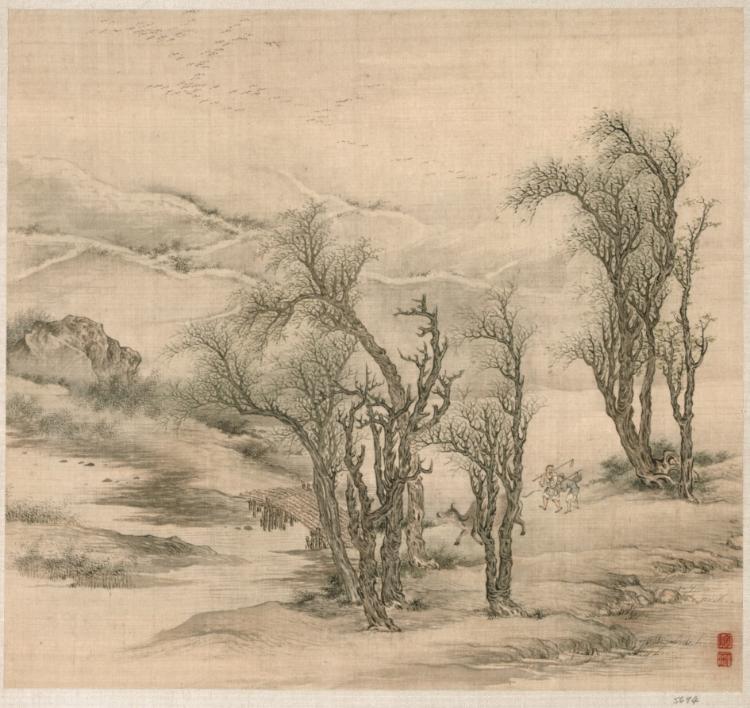
Although little known today, Tao Hong was a versatile artist who here depicts farmers returning home after a day in the fields. The shallow stream and dormant rice fields, the returning birds, and light sprinkles of green foliage all indicate the beginning of the farming season and hope for a good harvest. While the first leaf of this pair, 1999.223, depicts rural life, this one is of a more poetic nature. A lone crane stands in a bamboo grove. By using light colors and nuanced brushwork, Tao Hong achieves an effect of natural light and luminosity.
Provenance
[]
Accession Number
1999.224
Medium
album leaf, ink and color on silk
Dimensions
Overall: 24.5 x 26.7 cm (9 5/8 x 10 1/2 in.)
Classification
Painting
Credit Line
Gift of Dr. and Mrs. Sherman E. Lee
Tags
Painting Baroque (1600–1750) Ink Silk Painting Chinese Color: White
Background & Context
Background Story
Tao Hong (active early 1600s) was a Chinese painter known for the elegantly composed, precisely observed paintings of bird and flower subjects that make him one of the accomplished painters of the Ming dynasty. A Solitary Crane in the Bamboo Grove from the early 1600s depicts a solitary crane in a bamboo grove in the elegantly composed, precisely observed manner that distinguishes Tao Hong's best work from the more general bird and flower painting of his contemporaries. The crane—symbolizing longevity and spiritual elevation in Chinese culture—set within a bamboo grove—symbolizing moral integrity—creates a richly symbolic subject, and Tao Hong's elegantly composed treatment shows the Chinese bird and flower painting tradition at its most refined.
Cultural Impact
A Solitary Crane in the Bamboo Grove is important in the history of Chinese painting because it demonstrates the elegantly composed, precisely observed manner of the Ming dynasty bird and flower painting tradition as practiced by Tao Hong. The crane—symbolizing longevity and spiritual elevation—set within a bamboo grove—symbolizing moral integrity—creates one of the most richly symbolic subjects in Chinese painting, and the early 1600s painting shows this tradition at its most elegantly composed.
Why It Matters
A Solitary Crane in the Bamboo Grove is Tao Hong's elegantly composed Ming bird and flower painting: a solitary crane in a bamboo grove rendered in the precisely observed manner of one of the accomplished painters of the Ming dynasty. The early 1600s painting shows one of the most richly symbolic subjects in Chinese painting at its most elegantly composed.