Description
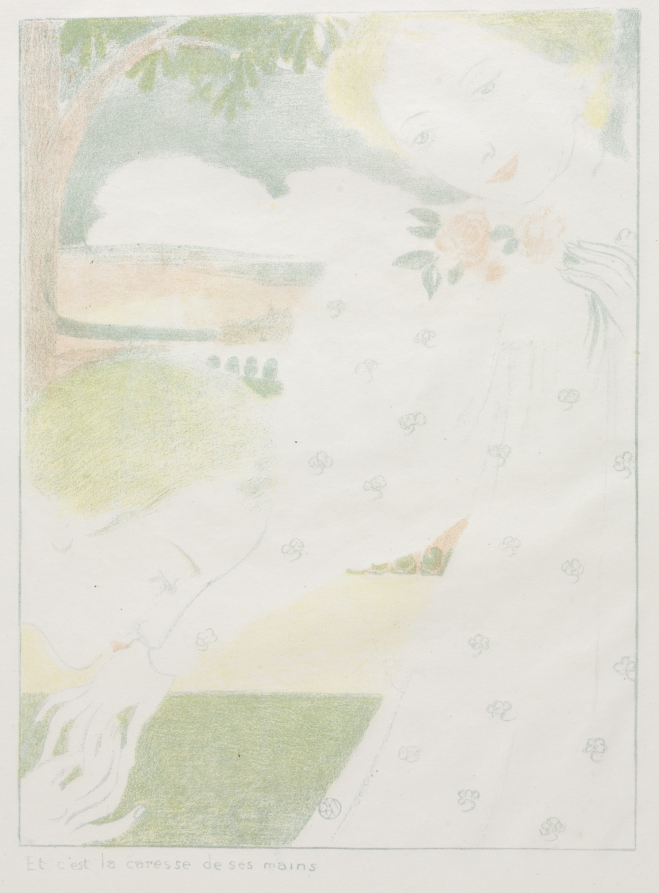
This portrait of the artist’s sister-in-law, Eva Meurier, expresses her talent as a musician through the fine, sinuous hands, while her face seems imperturbably focused on intimate thoughts. Denis intentionally painted the portrait on a fragment of an abandoned picture, hints of which cleverly appear in the openings in the background and around the edges of the composition, as if Eva’s portrait is emerging from an earlier painting.
Provenance
Maurice Denis; one of his sons until 2002.
Accession Number
2002.92
Medium
oil on canvas
Dimensions
Framed: 72.7 x 56.5 x 6.4 cm (28 5/8 x 22 1/4 x 2 1/2 in.); Overall: 55 x 38 cm (21 5/8 x 14 15/16 in.)
Classification
Painting
Credit Line
Mr. and Mrs. William H. Marlatt Fund
Tags
Painting Impressionist & Modern (1851–1900) Oil Painting Canvas French Color: Yellow
Background & Context
Background Story
Eva Meurier in a Green Dress from 1891 is a portrait from the earliest phase of Denis's Nabi period, depicting a woman in a green dress with the flat, decorative treatment that defines the Nabi style. The portrait demonstrates Denis's theoretical principle that a painting is 'essentially a flat surface covered with colors arranged in a certain order'—Eva Meurier's figure is rendered as a pattern of colors on a flat surface rather than as an illusion of three-dimensional space. The 1891 date makes this one of the earliest Nabi portraits, painted in the same year that Denis would publish his famous definition of painting in the magazine Art et Critique.
Cultural Impact
Eva Meurier in a Green Dress is one of the earliest Nabi portraits and a demonstration of Denis's theoretical principle in practice. The flat, decorative treatment of the figure—reducing the woman and her green dress to a pattern of colors on a flat surface—is the practical application of the famous definition that Denis would publish later in 1891: 'Remember that a painting, before it is a battle horse, a nude woman, or some anecdote, is essentially a flat surface covered with colors arranged in a certain order.'
Why It Matters
Eva Meurier in a Green Dress is Denis's Nabi theory made visible: a woman in a green dress reduced to a pattern of colors on a flat surface, the practical application of his famous definition that a painting is 'essentially a flat surface covered with colors arranged in a certain order.' The 1891 date makes this one of the theoretical foundations of modern abstract painting.