Description
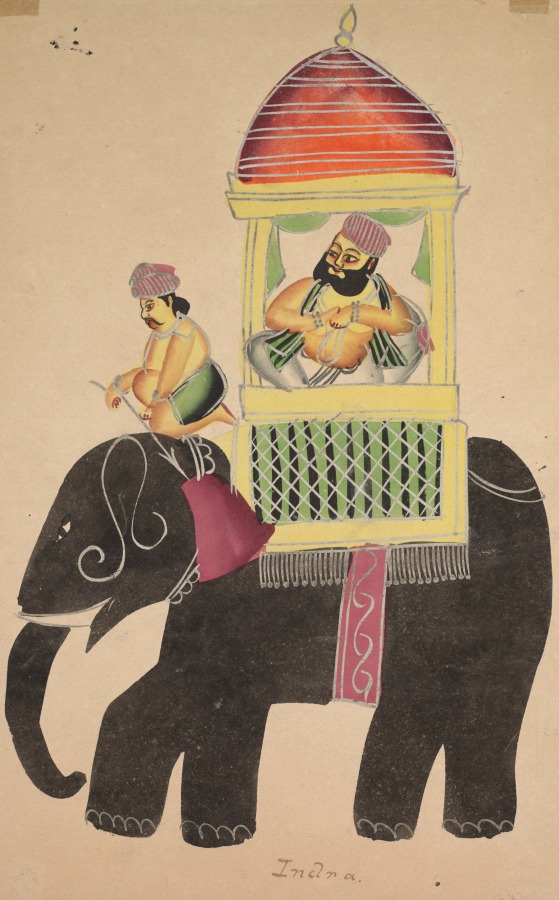
The Tarakeshwar murder case of 1873 was a public scandal in Calcutta. It concerned an affair between Elokeshi, a young wife, and the chief priest of the Shiva temple at Tarakeshwar. Having learned about the affair, her jealous husband cut Elokeshi’s throat with a fish knife on May 27, 1873. In the subsequent trial, the husband, Banerji, was sentenced to life imprisonment and the priest was fined and imprisoned for three years. Several Bengali plays and Kalighat images were inspired by this affair and depicted events that did not actually occur but were imagined by the artist. The Mahant (head priest), the adulterer, is here depicted atop an elephant, a symbol of royalty and status. While it is not known whether he actually rode an elephant, his depiction astride one indicates the Mahant’s power and affluence, setting the stage for other images of the scandalous Tarakeshwar murder of 1873.
Provenance
William E. Ward [1922-2004], Solon, OH, given to the Cleveland Museum of Art (?-2003); The Cleveland Museum of Art, Cleveland, OH (2003-)
Accession Number
2003.104
Medium
Gum tempera, graphite, ink, and tin on paper
Dimensions
Secondary Support: 60.8 x 42.3 cm (23 15/16 x 16 5/8 in.); Painting only: 45.4 x 27.8 cm (17 7/8 x 10 15/16 in.)
Classification
Painting
Credit Line
Gift of William E. Ward in memory of his wife, Evelyn Svec Ward