
Description
After four years of traveling in exile, fleeing Afghan forces, Humayun reached Tabriz, the glittering capital of the Safavid dynasty in northwestern Iran, here imaginatively rendered by the Indian artist. There the second Mughal emperor enjoyed warm hospitality extended by the shah of Iran, who called for a game of wolf-running for which the city was famous. Artists painting during the time of Akbar, late in his reign when historical subjects dominated, speculated as to how the game was played, based on eyewitness accounts. They gave the figures lively emotive expressions and gestures, and the dense crowding successfully conveys the pandemonium of the scene.
Provenance
Private Collection, London
Accession Number
2003.38
Medium
Gum tempera, ink, and gold on paper
Dimensions
Page: 35.2 x 23.8 cm (13 7/8 x 9 3/8 in.)
Classification
Painting
Credit Line
Alma Kroeger Fund
Tags
Painting Renaissance (1400–1599) Ink Tempera Gold Leaf Paper Indian Color: Orange
Background & Context
Background Story
This illustration from the Akbar-nama (Book of Akbar) depicts the game of wolf-running in Tabriz, a scene from the early life of the Mughal emperor Humayun, who spent four years in exile in Safavid Iran after losing his throne to Afghan forces. The painting shows Humayun enjoying the glittering court of Tabriz, the capital of the Safavid dynasty, where the Indian artist has imaginatively rendered the city's architecture and the spectacle of a royal hunt.
The Akbar-nama is the official chronicle of the reign of Akbar the Great (r. 1556-1605), commissioned by the emperor himself and written by his court historian Abu'l-Fazl. Its lavish illustrations, produced by the imperial painting workshop at Fatehpur Sikri, represent the pinnacle of Mughal manuscript painting — a synthesis of Persian, Indian, and European visual traditions that created one of the most sophisticated artistic cultures in world history.
This illustration was painted by an artist identified as Banavari 1 — one of the many skilled painters who worked in Akbar's imperial workshop under the direction of the master painters Mir Sayyid Ali and Abd al-Samad. The Mughal workshop system, modeled on the Persian kitabkhana (royal library-studio), combined the talents of multiple artists on each page: one specialist drew the composition, another applied color, and a master painter added the finishing details. The result was a level of technical perfection that no single artist could achieve alone.
The scene depicts a practice known as "wolf-running" — a form of royal entertainment in which wolves were captured and released for the amusement of the court. The Tabriz setting is rendered with the Mughal artist's characteristic blend of precision and fantasy: the architecture is recognizably Persian (with its domes, tilework, and iwan arches) but is filtered through an Indian pictorial sensibility that emphasizes brilliant color, precise detail, and animated figure groups. The use of gold, the vivid mineral pigments, and the fine brushwork are hallmarks of Mughal court painting at its most accomplished.
The historical context of this illustration is significant: Humayun's exile in Safavid Iran (1543-1544) was a turning point in Mughal cultural history. The Persian court introduced him to Safavid painting, which he brought back to India and which profoundly influenced the development of Mughal art. The very existence of this illustration — a Mughal painting depicting a Persian court scene — embodies this cross-cultural exchange.
Cultural Impact
The Akbar-nama illustrations represent the synthesis of Persian, Indian, and European artistic traditions that defined Mughal court painting at its zenith, creating a visual language of imperial power that influenced art across South Asia.
Why It Matters
This illustration captures Mughal imperial painting at its most accomplished — a vividly imagined scene of Persian court life rendered with Indian brilliance, embodying the cross-cultural exchange that made Mughal art one of the world's great painting traditions.
Related Artworks
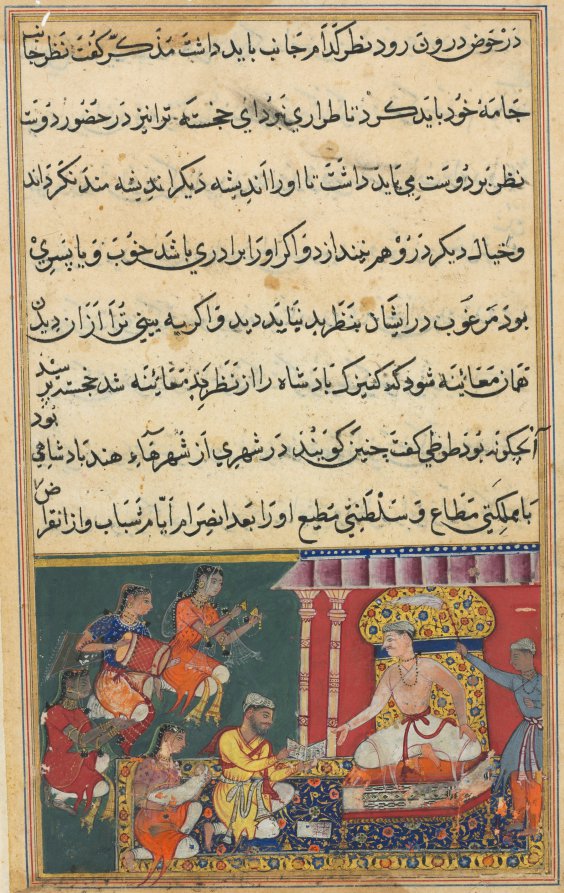
The astrologer predicts a calamity for the newly born prince in his thirteenth year, but one which he would be able to overcome, from a Tuti-nama (Tales of a Parrot): Eighth Night
Banavari 1
Saint James Major
Grifo di Tancredi
Saint Paul and a Group of Worshippers
Daddi, Bernardo
![Saint Bernard and Saint Catherine of Alexandria with the Virgin of the Annunciation [right panel]](https://api.nga.gov/iiif/e6890364-4d99-4684-a62b-5060ee3c3446/full/400,/0/default.jpg)
Saint Bernard and Saint Catherine of Alexandria with the Virgin of the Annunciation [right panel]
Gaddi, Agnolo