Description
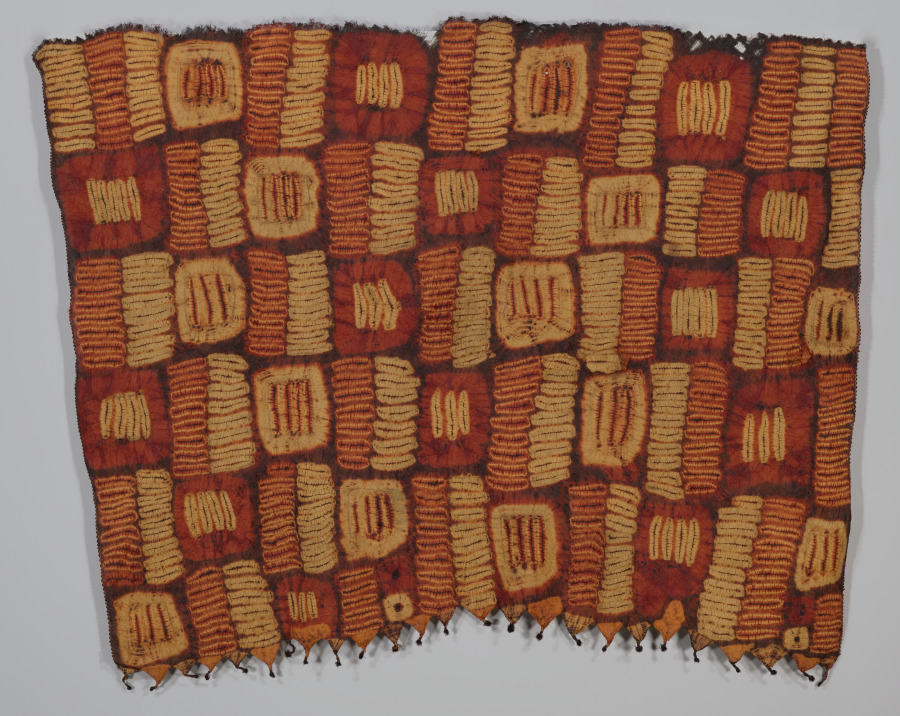
Displayed flat to highlight its designs and preserve its delicate fibers, this wrapper was meant to drape around the body. An elite man wore it with one corner over a shoulder, the knotted fringe skimming his ankles. The garment gained its earth-toned geometric patterns through plangi, a knot-and-twist resist dyeing technique; each color is applied in a different dye bath, from lightest to darkest. While their patterns are unique, these garments reflect regional influence: Dida women likely learned hand interlacing from Liberian Kpelle weavers. Such garments were given as gifts or worn on special occasions, at least into the 1990s.
Provenance
(David Lantz, New York, NY, sold to the Cleveland Museum of Art) (2003); The Cleveland Museum of Art, Cleveland, OH (2003-)
Accession Number
2003.89
Medium
Raffia palm fiber (Raphia ruffia or R. vinifera) and dye
Dimensions
Overall: 169.8 x 211.5 cm (66 7/8 x 83 1/4 in.)
Classification
Textile
Credit Line
John L. Severance Fund