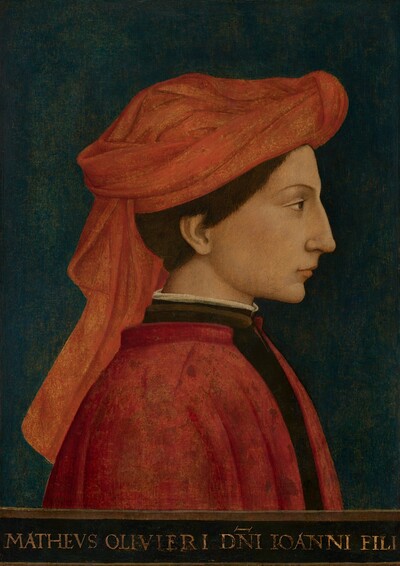
Description
François LePage belonged to a family of flower painters and worked in the French city of Lyon, which was famous for producing silk, particularly fabric with flower motifs. Flower painting was a specialty associated with the Lyon school of painting, and is a subject that requires both delicacy and dexterity, both of which are highlighted in this small self-portrait.
Provenance
(Heim Gallery, London, 1972);; Dr. and Mrs. Sherman E. Lee, by gift to the Cleveland Museum of Art, 2004.
Accession Number
2004.17
Medium
oil on canvas
Dimensions
Framed: 51 x 42 x 4.5 cm (20 1/16 x 16 9/16 x 1 3/4 in.); Unframed: 41.3 x 32.8 cm (16 1/4 x 12 15/16 in.)
Classification
Painting
Credit Line
Gift of Dr. and Mrs. Sherman E. Lee in honor of Henry Hawley
Tags
Painting Neoclassical & Romantic (1751–1850) Oil Painting Canvas French Color: Orange Color: Brown Color: White
Background & Context
Background Story
Francois LePage (active early 19th century) was a painter known for the precisely observed, characterfully composed self-portraits that make him one of the accomplished painters of the early 19th-century French tradition. Self-Portrait from 1824 depicts the artist himself in the precisely observed, characterfully composed manner that distinguishes LePage's best work. Self-portraits were one of the most important subjects in Western painting, representing the artist's engagement with the tradition of self-examination and self-representation, and the 1824 date places this in the period of French Neoclassicism and early Romanticism.
Cultural Impact
Self-Portrait is important in the history of French painting because it demonstrates the precisely observed, characterfully composed manner that LePage brought to self-portraiture. Self-portraits—representing the artist's engagement with the tradition of self-examination and self-representation—were one of the most important subjects in Western painting, and the 1824 self-portrait shows this tradition at its most precisely observed in the early 19th-century French tradition.
Why It Matters
Self-Portrait is LePage's precisely observed French self-portrait: the artist depicted in the characterfully composed manner of the early 19th-century French tradition. The 1824 painting shows the tradition of self-examination and self-representation at its most precisely observed.
![Saint Bernard and Saint Catherine of Alexandria with the Virgin of the Annunciation [right panel]](https://api.nga.gov/iiif/e6890364-4d99-4684-a62b-5060ee3c3446/full/400,/0/default.jpg)