Description
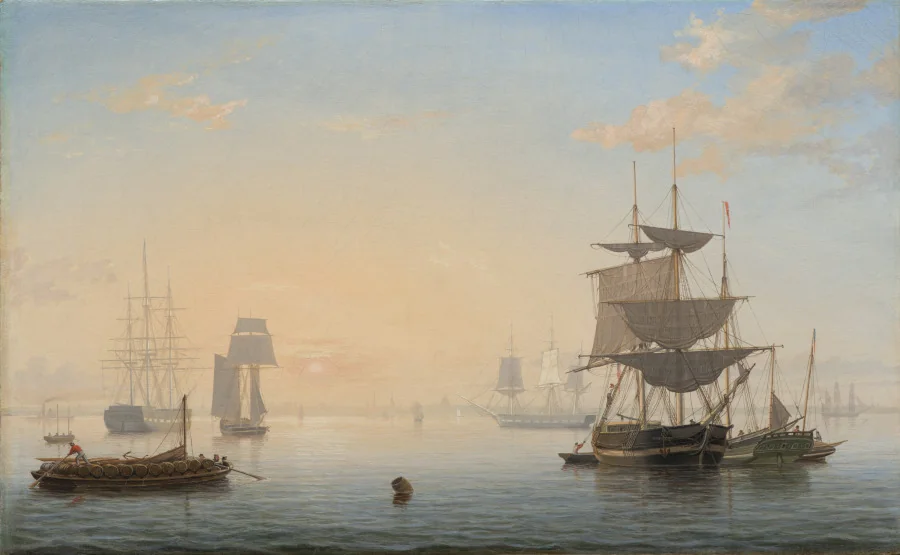
In this late afternoon view of Boston Harbor, Lane masterfully evoked the diffuse quality of sunlight reflecting off water. The artist was a son of a shipbuilder, so perhaps it is not surprising that his renderings of ships and their intricate riggings are painstakingly accurate. On the far left side of the painting, evolving technology appears in the guise of a steamboat, which ferried passengers between Boston and Gloucester.
Provenance
Dr. James H. Armsby, Albany, NY, acquired 1847; Joanna Perry Armsby March, sister of Dr. J.H. Armsby, Albany, NY; Joanna Armsby March Boyd, daughter of Joanna March, Albany, NY; Alden March Boyd, son of Joanna Armsby March Boyd, Santa Barbara, CA; Joanna March Boyd Bard, daugher of Alden March, Santa Barbara, CA; Henry Travers Newton, Jr, Joanna Newton Riccardi, and Georgia Newton Pulos, grandchildren of J.M.B. Bard, Santa Barbara, CA
Accession Number
2004.35
Medium
oil on canvas
Dimensions
Framed: 66 x 104.8 x 14 cm (26 x 41 1/4 x 5 1/2 in.); Unframed: 43.2 x 68.6 cm (17 x 27 in.)
Classification
Painting
Credit Line
Leonard C. Hanna Jr. Fund and partial gift of Travers Newton, Joanna Newton Riccardi and Georgia Newton Pulos
Tags
Painting Neoclassical & Romantic (1751–1850) Oil Painting Canvas American Color: White
Background & Context
Background Story
Harbor of Boston, with the City in the Distance is an early work by Lane, painted before he had fully developed the luminist style that would make his reputation. The harbor, the shipping, and the distant city are rendered with the topographic precision that would always characterize his work, but the atmospheric effects are less still and the light less crystalline than in his mature paintings. The 1846-47 date places this in Lane's formative period, when he was still working in the tradition of marine topography that he had inherited from his predecessors, before he had developed the radical simplification of atmospheric effect that distinguishes his mature luminism.
Cultural Impact
Lane's early harbor paintings, like this view of Boston, are important documents because they show the tradition from which luminism emerged. The topographic accuracy, the careful rendering of shipping, and the panoramic view of the city all derive from the marine topography tradition, but the atmospheric effects—the translucent light on the harbor, the suggestion of infinite distance—are proto-luminist, pointing toward the style that Lane would develop in the 1850s and 1860s.
Why It Matters
Harbor of Boston is Lane before luminism: the topographic precision and marine accuracy are fully developed, but the crystalline stillness that would distinguish his mature work is not yet in place. The painting is a document of luminism's origins—showing the tradition from which Lane's revolutionary simplification of atmospheric effect would emerge.

![Saint Bernard and Saint Catherine of Alexandria with the Virgin of the Annunciation [right panel]](https://api.nga.gov/iiif/e6890364-4d99-4684-a62b-5060ee3c3446/full/400,/0/default.jpg)