Description
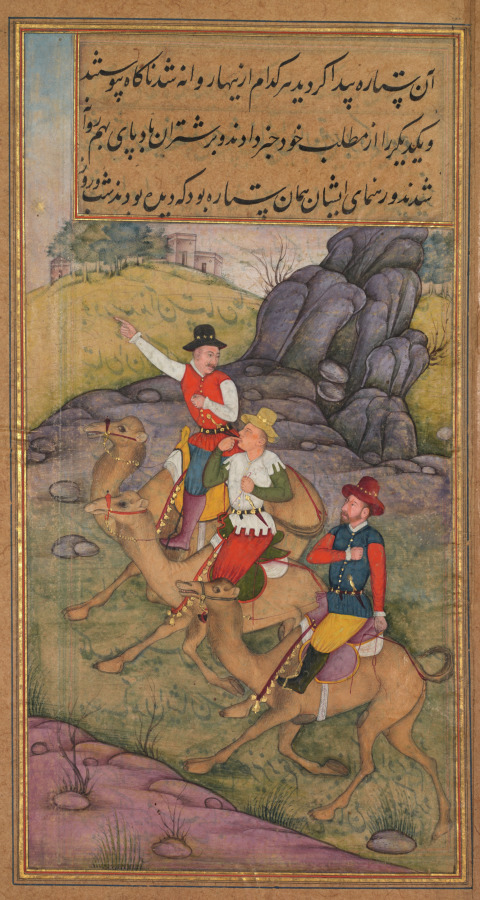
One of the three kings points excitedly at the star at the upper left edge of the page, while another bites the finger of astonishment; the third holds his fist over his heart. They are all dressed like Portuguese merchants, but they ride camels associated with their homeland in Arabia, as specified in the text.
The Westerners whom Mughals would have seen, besides priests, were mainly merchants from the Portuguese port of Goa on India’s western coast. They regularly visited Akbar to negotiate trade agreements, so they served as the primary visual model for all nonclerical Europeans. The artists who produced this manuscript worked for Akbar before joining Prince Salim at his rebel court in Allahabad.
The Westerners whom Mughals would have seen, besides priests, were mainly merchants from the Portuguese port of Goa on India’s western coast. They regularly visited Akbar to negotiate trade agreements, so they served as the primary visual model for all nonclerical Europeans. The artists who produced this manuscript worked for Akbar before joining Prince Salim at his rebel court in Allahabad.
Provenance
An Indian family in Great Britain, whose grandfather brought the manuscript to England in the 1930s or 1940s (before 1930s–2005); (Oliver Forge and Brendan Lynch Ltd., London, England, sold to the Cleveland Museum of Art) (2005); The Cleveland Museum of Art, Cleveland, OH (2005–)
The Magi Follow the Star (folio 34 recto), from a Mirror of Holiness (Mir’at al-quds) of Father Jerome Xavier
1602–4
Accession Number
2005.145.34.a
Medium
Gum tempera, ink, and gold on paper
Dimensions
Sheet: 26.2 x 15.7 cm (10 5/16 x 6 3/16 in.); Image: 20.6 x 10.9 cm (8 1/8 x 4 5/16 in.)
Classification
Manuscript
Credit Line
John L. Severance Fund