Description
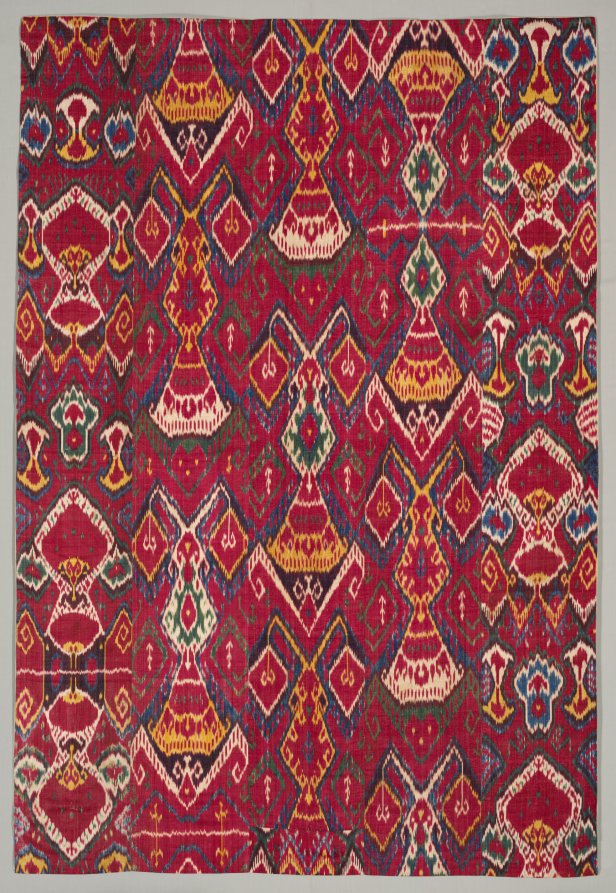
Dazzling patterns with saturated colors in the ikat technique provided vibrant wall hangings in reception rooms of the urban elite in Central Asia. In this splendid example composed of five loom widths, the three central lengths display a precise design of amulets complemented by palmettes in the two outer lengths. The irregular contours, telltale indicators of ikat, are masterfully controlled with five rich colors, illustrating the high quality of the earliest known examples in Central Asia from the first half of the 1800s. In the ikat technique, the design was dyed on the warp before it was woven in a resist-dye process. Thread was tightly wrapped around the warp to resist dye penetration for each area of color. This labor-intensive process created hangings and garments cherished for their vibrant colors with "fuzzy" contours.
Provenance
Dr. Guido Goldman [1937–2020], New York, NY, given to the Cleveland Museum of Art (?–2006); The Cleveland Museum of Art, Cleveland, OH (2006–)
Accession Number
2006.150
Medium
Silk: warp-faced plain weave, warp-ikat; cotton weft
Dimensions
Overall: 211.8 x 142.2 cm (83 3/8 x 56 in.)
Classification
Textile
Credit Line
Gift of Guido Goldman