Description
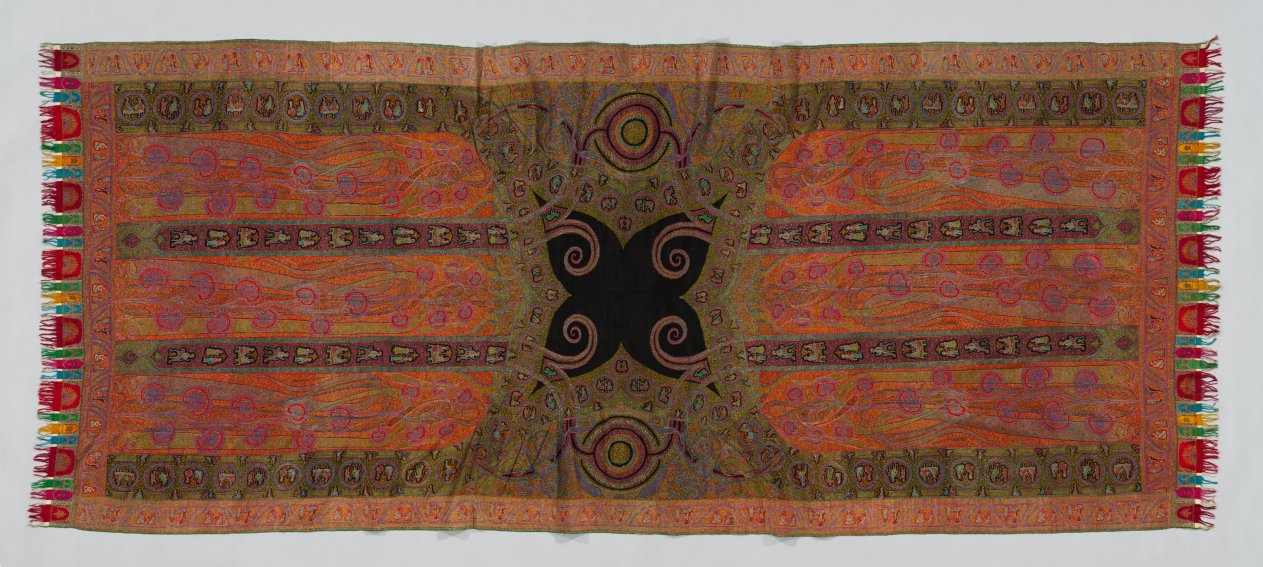
Kashmir shawls from India were status symbols in Europe during the 1800s, and few are as rare as this woven example. Over 200 human figures take part in drinking, smoking, dancing, and falconry in the Indian princely scenes that enliven the shawl’s borders and four dark stripes. The stripes alternate with large elongated boteh, or paisley, motifs that intertwine with blossoming stems in a European style adapted by Kashmiri textile artists. This extraordinary woven shawl was probably made to dazzle the jury at one of the European expositions of industrial products, as almost all other figural shawls were embroidered. It was woven in many pieces and then skillfully joined with colorful harlequin end borders.
Provenance
Arlene C. Cooper [1939–2019], New York, NY, given to the Cleveland Museum of Art (?–2006); The Cleveland Museum of Art, Cleveland, OH (2006–)
Accession Number
2006.200
Medium
2/2 twill tapestry weave, double interlocked and pieced: wool (possibly pashmina)
Dimensions
Overall: 354.3 x 141.6 cm (139 1/2 x 55 3/4 in.)
Classification
Textile
Credit Line
Gift of Arlene C. Cooper