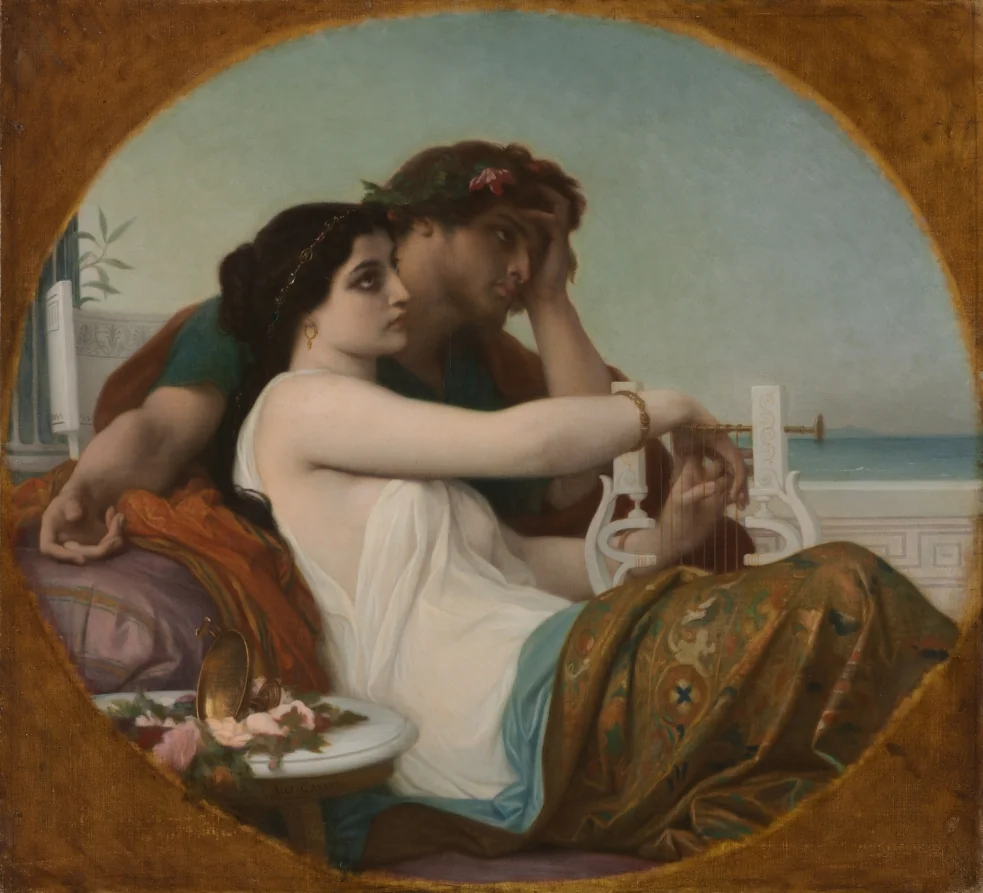
Description
The French painter Alexandre Cabanel was a favorite of Emperor Napoleon III and a leader of the academic style that emphasized precise drawing and smoothly modeled forms. This painting depicts the wealthy Roman woman Aglaida and her concubine slave Boniface, here living as pagan sinners in Rome around 290 CE. On a trip to Tarsus on the Anatolian coast, Boniface converted to Christianity and was tortured and beheaded. Aglaida also converted to Christianity, gave all her possessions to the poor, and built a church for Boniface's relics.
Provenance
Elizabeth Ludwig Fennell [1917–2007], Cleveland, OH, bequested to the Cleveland Museum of Art (?–2007); The Cleveland Museum of Art, Cleveland, OH (2007–)
Accession Number
2007.275
Medium
oil on canvas
Dimensions
Unframed: 62.2 x 68 cm (24 1/2 x 26 3/4 in.)
Classification
Painting
Credit Line
Bequest of Elizabeth Ludwig Fennell
Tags
Painting Impressionist & Modern (1851–1900) Oil Painting Canvas French Color: Orange
Background & Context
Background Story
Alexandre Cabanel's "Aglaida and Boniface" (c. 1857) depicts the story of two affluent Roman pagans — the wealthy noblewoman Aglaida and her concubine slave Boniface — who lived in pagan debauchery in Rome around 270 CE before converting to Christianity and dying as martyrs. The painting illustrates the moment before their conversion, showing the couple in the plush luxury of their sinful life. Cabanel renders them with the voluptuous physical beauty and impeccable technique that made him Napoleon III's favorite painter and the embodiment of French academic art at its most seductive.
Cabanel (1823–1889) was the most celebrated painter of the French Second Empire and the quintessential academic artist. His "Birth of Venus" (1863) — purchased by Napoleon III himself and now in the Musée d'Orsay — epitomized the smooth, idealized style that the official art establishment championed against the rough, unpolished realism of Courbet and the emerging Impressionists. As a professor at the École des Beaux-Arts and a member of the Institut de France, Cabanel wielded enormous influence over French artistic taste, training hundreds of students in the principles of academic drawing and composition.
"Aglaida and Boniface" demonstrates the seductive power of academic painting at its best. Cabanel's technique is flawless: the flesh tones have the luminous, porcelain quality that the French called "peau d'orange" (orange-skin texture), the drapery falls in convincing folds, and the composition is balanced with the mathematical precision that academic theory demanded. But the painting is also surprisingly sensual for a subject that is ostensibly religious — the naked flesh, the languid poses, and the opulent furnishings transform a story of Christian conversion into an exercise in pagan pleasure.
This tension between religious subject matter and sensual treatment was characteristic of French academic painting. The story of Aglaida and Boniface allowed Cabanel to paint erotic content under the cover of moral edification — a strategy that was well understood by contemporary audiences and critics. The painting thus embodies the paradox at the heart of academic art: its claim to moral seriousness coexists uneasily with its undeniable pleasure in physical beauty.
Cultural Impact
Cabanel's work represents the pinnacle of the French academic tradition — a style that dominated official taste for decades before being overthrown by Impressionism. Ironically, his emphasis on technical perfection and visual beauty has found renewed appreciation in recent decades as the academy's achievements have been reassessed.
Why It Matters
"Aglaida and Boniface" embodies the paradox of French academic painting — a religious subject rendered with voluptuous sensuality, demonstrating Cabanel's flawless technique and the seductive power of the style that dominated French art before Impressionism.
![Saint Bernard and Saint Catherine of Alexandria with the Virgin of the Annunciation [right panel]](https://api.nga.gov/iiif/e6890364-4d99-4684-a62b-5060ee3c3446/full/400,/0/default.jpg)