Description
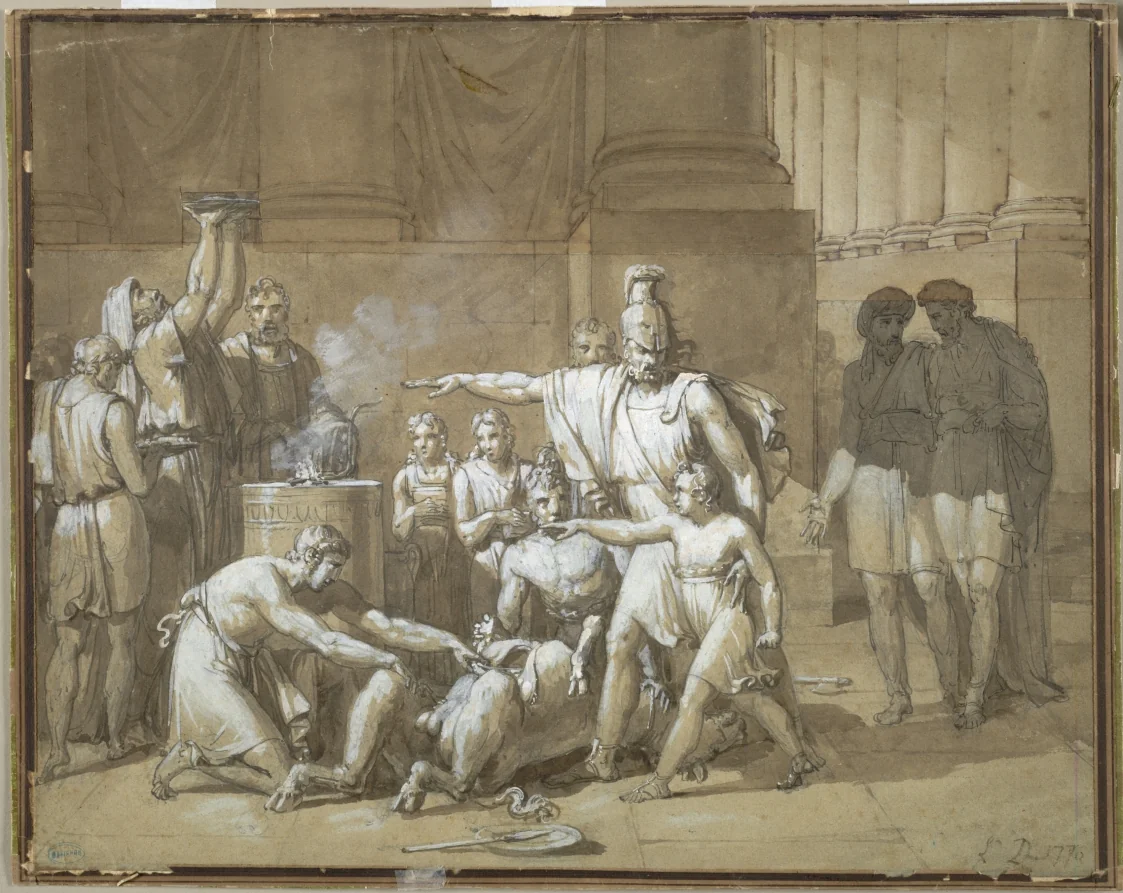
This scene from ancient history shows a moment in the boyhood of the great Carthaginian general Hannibal (247-about 183 bc). While sacrificing to the gods in preparation for a military campaign, Hannibal's father decided to have his son swear an oath to remain the eternal enemy of Rome. At the center of the composition, the nine-year-old Hannibal imitates the gesture and stance of his father, while a bull is sacrificed below. The unknown creator of the scene probably planned to make a larger painting of it because important events from antiquity, such as this one, were typical subjects for the period. In addition, the overall use of pen and brush with white highlights for modeling was a technique frequently used to finalize a composition before realization on a larger scale in oil.
Provenance
Emile-Louis Galichon (Lugt 1058, lower left, in blue ink); Louis Galichon (Lugt 1060, verso, center left, in blue ink). [Sotheby-Parke-Bernet, London (21 June 1979), no. 65]; purchased in 1979.
Accession Number
2008.349
Medium
pen and black and brown ink, brush and brown and gray wash, and white paint over graphite
Dimensions
Sheet: 34.4 x 42.9 cm (13 9/16 x 16 7/8 in.)
Classification
Drawing
Credit Line
Bequest of Muriel Butkin
Tags
Drawing Neoclassical & Romantic (1751–1850) Ink Graphite & Pencil Color: Brown
Background & Context
Background Story
Hannibal Swearing Eternal Enmity toward Rome from c. 1808 depicts the historical subject of Hannibal swearing eternal enmity toward Rome in the dynamically composed, classically inspired manner of the Neoclassical tradition. The subject of Hannibal swearing eternal enmity toward Rome was one of the most dramatic subjects from ancient history, and paintings depicting it represent one of the most accomplished traditions in Neoclassical painting. The c. 1808 date places this in the period of Neoclassicism, when artists were finding in ancient history examples of heroism and virtue that resonated with the political and social concerns of the Napoleonic era.
Cultural Impact
Hannibal Swearing Eternal Enmity toward Rome is important in the history of Neoclassical painting because it depicts one of the most dramatic subjects from ancient history in the dynamically composed, classically inspired manner of the Neoclassical tradition. The subject of Hannibal swearing eternal enmity toward Rome representing heroism and resistance against a powerful enemy was one of the most important subjects in Neoclassical painting, and the c. 1808 painting shows this tradition at its most dynamically composed.
Why It Matters
Hannibal Swearing Eternal Enmity toward Rome is an anonymous Neoclassical painting: the historical subject rendered in the dynamically composed manner of the Neoclassical tradition. The c. 1808 painting shows one of the most dramatic subjects from ancient history at its most dynamically composed.