Description
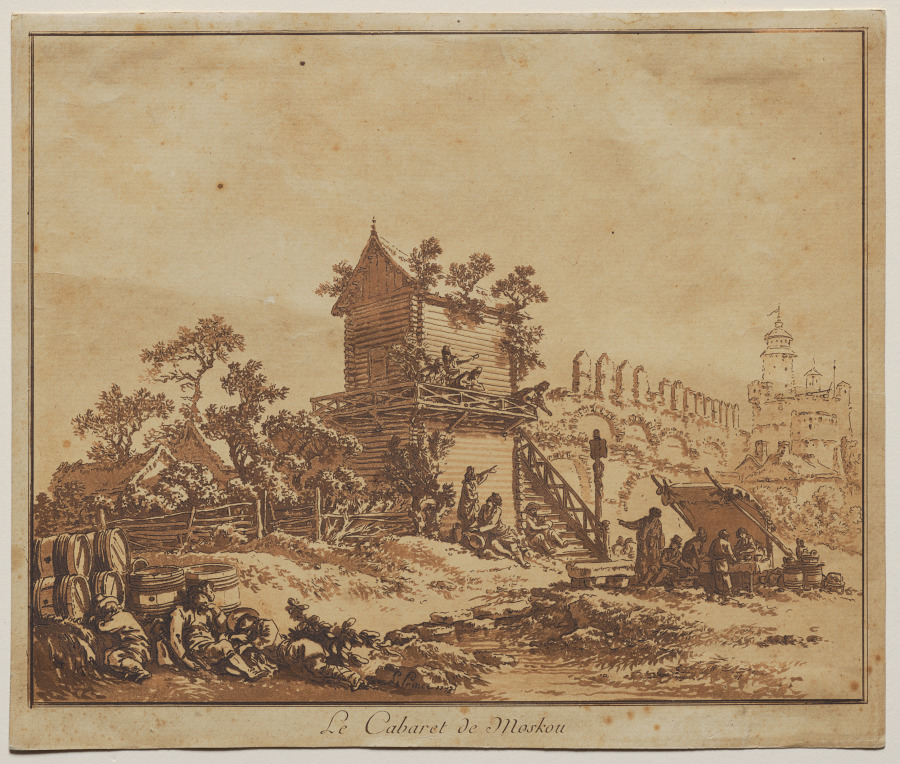
French art during the 1700s often reflects an interest in the exotic, especially in imagery of lands then perceived as far away and unusual-such as Turkey and China, places with religions and cultural practices different from those of Western Europe. Le Prince developed his own type of exotic imagery based on the peoples and customs of Russia. But unlike most artists, who fabricated fantastic visions of such places, he based his work on his own observations made in Russia between 1758 and 1763. After returning to Paris, Le Prince continued to rely on his Russian experiences for artistic subject matter. This drawing shows a rustic structure built as an outdoor pleasure garden and drinking establishment. Le Prince, who was an innovative printmaker, developed the medium known as aquatint, which allowed artists to translate the broad tonal washes of ink drawing into a type of etching. Le Prince translated this drawing into an aquatint. For more about this technique, see the exhibition about French printmaking on view nearby in galleries 109 and 110.
Provenance
[Christie's, London (9 December 1975), no. 78]; purchased in 1975.
Accession Number
2008.355
Medium
Pen and brown ink and brush and brown and gray wash on white laid paper
Dimensions
Sheet: 19.5 x 24.2 cm (7 11/16 x 9 1/2 in.)
Classification
Drawing
Credit Line
Bequest of Muriel Butkin
Tags
Drawing Neoclassical & Romantic (1751–1850) Ink Paper French Color: White
Background & Context
Background Story
The Moscow Tavern from c. 1773 is one of Le Prince's most characteristic Russian genre subjects, depicting a tavern scene in Moscow with the specific ethnographic detail and atmospheric pen and wash technique that distinguish his Russian drawings. The c. 1773 date places this after Le Prince's return from Russia, when he was producing the Russian genre subjects that made him one of the most popular painters of exotic subjects in Paris. The Moscow tavern scene allows Le Prince to exercise his talent for genre detail—the clothing, the gestures, the atmosphere of Russian popular life—within the pen and wash medium that he used for his most accomplished drawings.
Cultural Impact
Le Prince's Russian genre subjects were among the most popular exotic subjects in 18th-century Paris because they offered French viewers a glimpse of Russian popular life that was genuinely based on first-hand observation rather than the imaginative fantasies that characterized most Orientalist painting. The Moscow Tavern demonstrates Le Prince's ability to combine ethnographic observation with the atmospheric pen and wash technique that makes his Russian drawings as accomplished as works of art as they are as documents of Russian popular life.
Why It Matters
The Moscow Tavern is Le Prince's Russian genre at its most accomplished: a Moscow tavern rendered in pen and wash with the specific ethnographic detail and atmospheric technique that distinguish his Russian drawings from Orientalist fantasies. The c. 1773 drawing offers genuinely observed Russian popular life rather than imaginative exoticism.